Description
It is 5:40 in the morning, you have a temperature, and the substitute system wants your absence logged in twenty minutes. Somewhere in that twenty minutes you are supposed to write a full day of plans, remember which student cannot have the biscuits, explain where the hall passes live, and describe a fire-drill route in a way a stranger can follow while thirty children watch them.
That is the problem this binder solves. Not by being clever — by being already finished. You fill it in once, on a calm afternoon, and from then on being out is a phone call rather than an hour of typing.
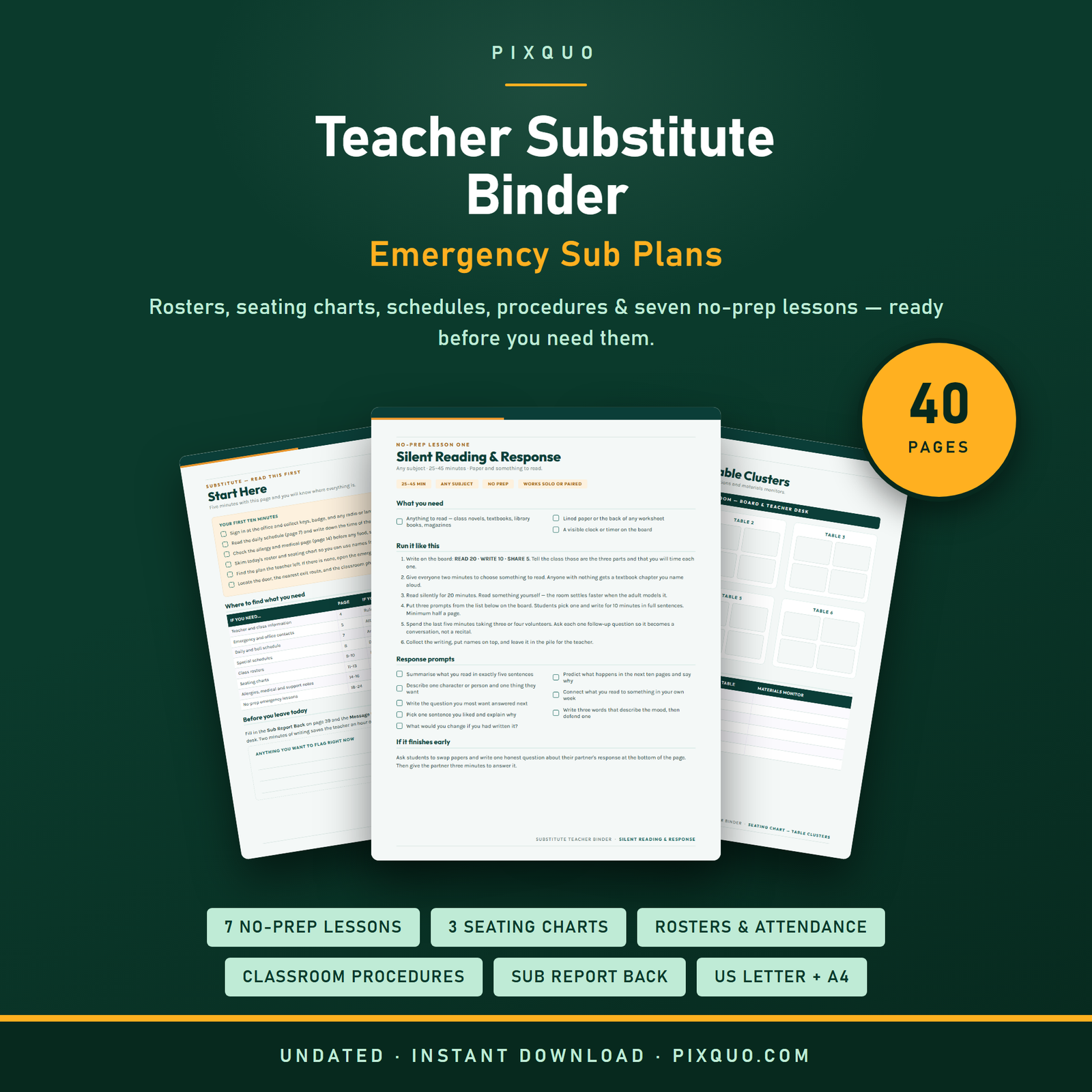
What’s inside — all 40 pages
Getting oriented (pages 1–5). A designed cover, a Start Here page written directly to the substitute with a first-ten-minutes checklist and a page-by-page index, a teacher setup guide with printing instructions and the usage terms, an About This Class sheet for teacher details and an honest description of the group, and an emergency contact directory with sixteen pre-labelled roles from the school nurse to the substitute coordinator, each with room, extension and mobile columns.
Schedules, rosters and seating (pages 6–13). A section divider, then a bell-by-bell daily schedule with fourteen rows plus space for students who leave or join partway through the day. A special schedules page covering assembly days, early release, and delayed start or testing days — three separate timing tables so nobody has to guess. Two class roster pages, each holding two classes of twenty with tick columns, which covers four periods or a full primary rotation. Then three different seating charts: a thirty-desk row layout, a fifteen-pair layout for shared desks and partner work, and a labelled six-table cluster layout with a materials-monitor table underneath. Every chart is drawn with the board and the front of the room marked, so it is obvious which way round it goes.
Student support (pages 14–16). An allergies and medical page that opens with a plain instruction to check it before any food, snack, reward or activity, followed by a table for what is on file and where supplies are kept. An accommodations at-a-glance page that works from a twelve-item key of generic labels only — preferential seating, extended time, reduced items, scribe or typing, read-aloud, movement break, small-group setting, assistive device and so on — so the substitute sees what to do without any confidential plan detail leaving the school office. Then a page splitting the class into students who can help (with the jobs worth handing them) and students who may need extra support, with a column for who to call.
Seven no-prep emergency lessons (pages 17–24). This is the part teachers actually reach for. Each lesson is written out as a real, runnable plan — time band, what you need, a numbered sequence, prompts, and what to do if it finishes early. None of them need a screen, a photocopier or any preparation at all.
- Silent reading & response — a timed READ 20 / WRITE 10 / SHARE 5 structure with eight written response prompts.
- Journal prompt & quick-write — the six-minute no-stopping rule, plus ten prompts that work from upper primary to sixth form.
- Vocabulary sort — sixteen words from any subject’s glossary, sorted, headed, then deliberately re-sorted a second way. Eight sorting angles to suggest if a pair stalls.
- Number talk — mental arithmetic with thumbs instead of hands, every answer written on the board including the wrong ones, then the methods compared. Comes with eight ready-made problem strings graded from lower to higher.
- Partner interview — six questions, six minutes each way, then a written profile with a direct quotation. Twelve questions in the bank, plus a subject variation for history, science and literature.
- Current-events summary — 5W+H, a three-sentence summary, what I still do not know, and how I would check it. Works with or without devices, with seven ground rules to put on the board.
- Brain-break menu — twelve timed resets from three to seven minutes, with how each one runs and how to bring the room back afterwards.
Planning and behaviour (pages 25–29). A daily lesson plan template with a running order, materials and a done column; a week-at-a-glance grid for longer absences; a classroom rules page with numbered write-in rules, a set of expectations any substitute can rely on, a 0–4 voice-level scale and a space for your attention signal; a behaviour management plan laying out a five-step ladder from non-verbal cue to phoning support, plus a short and useful “please do not” list; and a behaviour incident log with twelve rows for time, student, what happened, what I did and who I told.
Records and procedures (pages 30–36). A twenty-three-line attendance sheet with present, absent, tardy and excused-early columns; an eighteen-row tardy log; arrival and dismissal procedures with a bus, car, walker, club and early-leaver table; a bathroom, hall pass and technology page with its own pass log; a drill and emergency reference for you to fill in from your school’s own published plan; a twenty-two-item end-of-day checklist; and a where to find things page pairing twenty supply locations with a dot-grid box for sketching the room.
Handover (pages 37–40). A duty schedule for recess, lunch, bus and corridor cover; a who to ask for what page listing fourteen situations against the person who solves them; a sub report back covering what we did, what went well, what did not get finished, who helped and who to follow up with; and a message log for every call and doorway conversation, with a notes area underneath.
Who it’s for
Classroom teachers who want a sub binder ready before they need it. Substitutes and supply teachers who would rather walk in with their own organised system than hope one is waiting. Team leaders and department heads setting up a consistent format across several rooms. Homeschool co-op leads and tutors who hand a group to someone else occasionally. It works for primary and secondary, single-class and multi-period timetables, and it is completely undated, so it never expires.
How to use it
Print the set, punch it, and put it in a one-inch three-ring binder with four tabbed dividers. Fill in the teacher details, contacts and schedules first — those four pages answer most of a substitute’s questions on their own. Do the rosters, seating charts and support pages in pencil so they are quick to update each term. Write the procedures pages in your own words rather than assuming; a substitute follows what is written. Then print spare copies of the attendance sheet, incident log, report-back and message log and slide them into the back pocket, and leave the binder in the same visible place every day. Tell the office where it lives.
Formats & what you receive
Two ready-to-print PDF bundles — US Letter (8.5 × 11 in) and A4 (210 × 297 mm) — plus all 40 pages as individual PDFs in both sizes, so you can reprint one roster or one attendance sheet without printing the whole binder. Print at 100% scale or fit-to-page with borderless printing switched off. The design is built to stay readable in greyscale, so black-and-white printing on ordinary copy paper loses nothing.
More for the classroom
Pair this binder with the teacher lesson and class planner for your own week-to-week planning, the homeschool planner and record keeper if you also teach at home, and the self-care and wellness journal for the term when everything lands at once. For more, browse the planners and productivity collection or start with the free printables library.
Frequently asked questions
Is this dated to a particular school year?
No. Every page is undated. You write the dates in yourself, which means the same printed binder carries over from one year to the next — you only reprint the pages whose contents change, usually the rosters and seating charts.
Does it work for secondary as well as primary?
Yes. The roster pages hold four separate classes or periods, the daily schedule is bell-by-bell rather than block-by-block, and the seven emergency lessons are written to run in any subject. Primary teachers tend to use fewer roster pages and more of the routine and dismissal pages; secondary teachers use the reverse.
What exactly are the “no-prep” lessons?
Seven complete, timed activities that need nothing but paper, pencils and a board — silent reading and response, a journal quick-write, a vocabulary sort, a number talk, a partner interview, a current-events summary and a brain-break menu. Each one is written as instructions a substitute can read aloud and follow, with prompts and an early-finisher option, so no photocopying or technology is required.
Is it editable, or do I fill it in by hand?
This is a print-and-write binder, filled in by hand. The fields, grids and tick boxes are sized for a pen, and a physical binder is far easier to hand to a stranger at 7am than a shared file they cannot open. Filling the rosters and charts in pencil makes updating them quick.
Will it print on my printer?
Both US Letter and A4 versions are included, so use whichever matches your printer. Any home or school inkjet or laser printer handles it. Standard copy paper is fine; 90–120 gsm (24–32 lb) stands up better to repeated handling in a binder that lives on a desk all year.
Licence & instant download
This is a digital product. Your files are available to download immediately after purchase — nothing is posted to you and there are no shipping costs. Because the files are delivered instantly, this purchase is non-refundable; please check that your printer handles US Letter or A4 before buying.
Licensed for personal, single-classroom use by the purchaser. Print as many copies as you need for your own classroom and share printed pages with a substitute, a colleague covering your room or your school office. You may not resell, share or redistribute the digital files, sell printed copies, or use the design in another product. Nothing in this binder is legal, medical or educational advice — always follow your own school’s written policies and procedures.
Explore More Digital Tools
- Browse the full shop — planners, trackers, prompt packs and printables
- Free printables library
- Budgeting & saving guide · Planners & productivity guide
- Paper sizes & currency by country
Every Pixquo product is an instant download — no shipping, no waiting.
Reviews
There are no reviews yet.