
Description
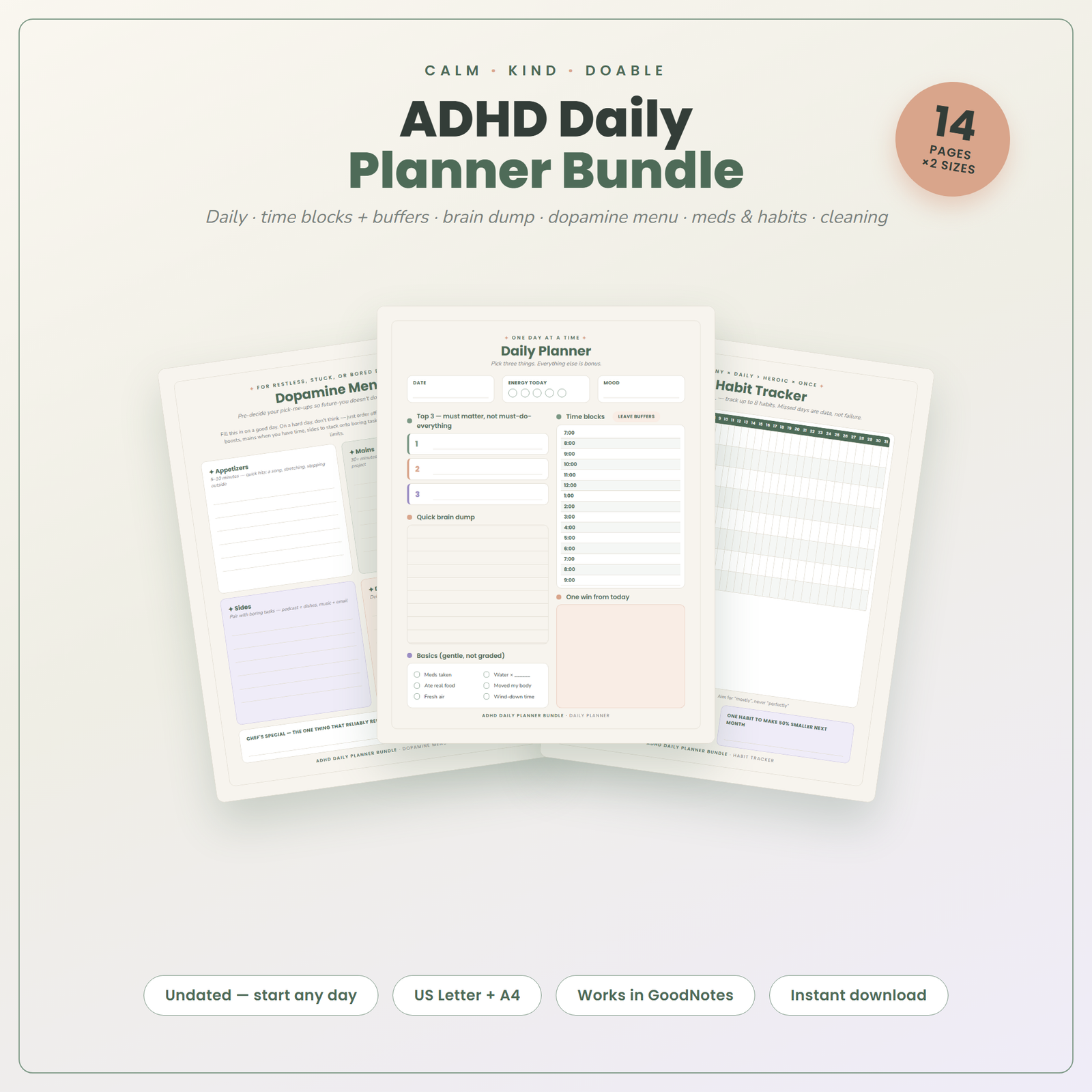
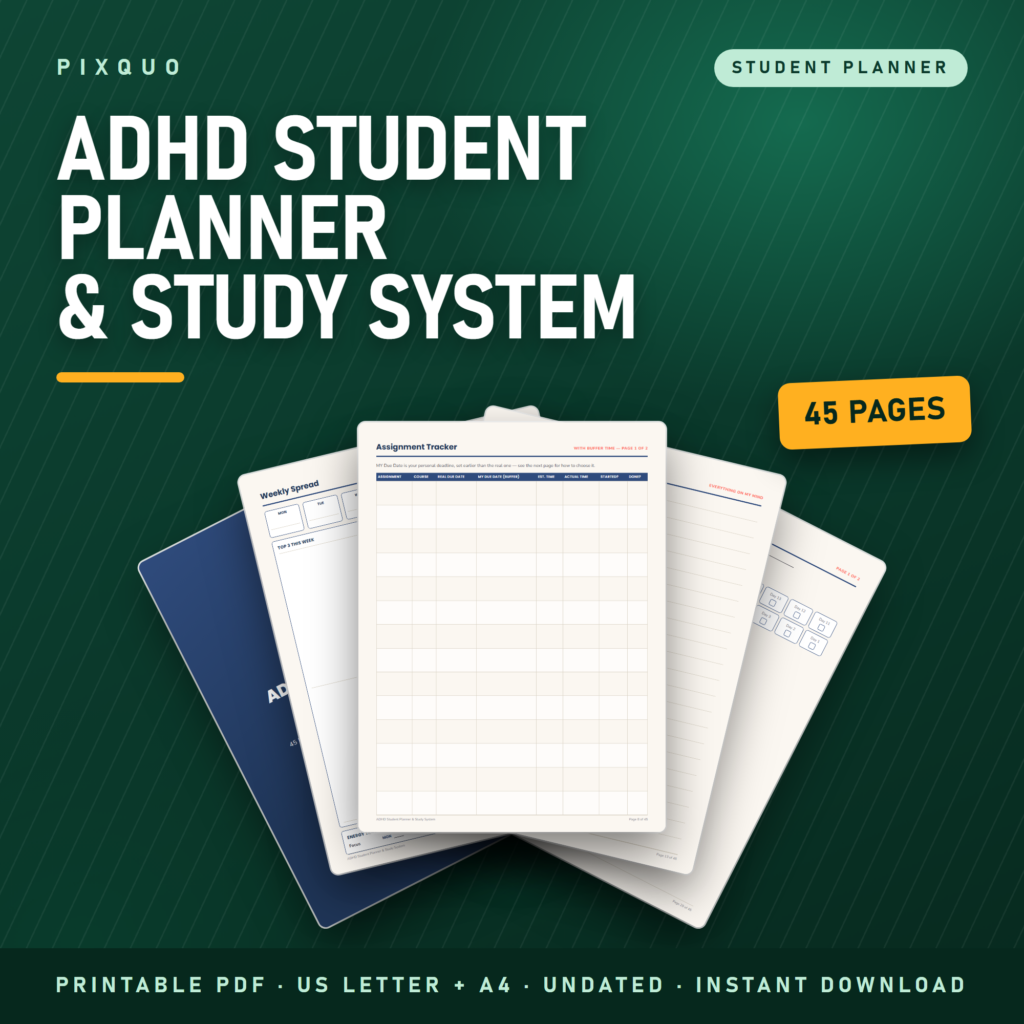
The calm, structured ADHD planner system: 14 pages designed for real executive-function life — Top-3 daily planner with time blocks, low-energy day page, weekly overview, time blocking with buffer column, 4-quadrant brain dump, dopamine menu, 31-day habit tracker, 31-day medication tracker, cleaning routines, weekly reset, Now/Next/Later priority matrix and dot-grid notes.
If you have ever bought a beautiful planner in January and abandoned it by February, this bundle was built for you. Most planners assume you wake up with steady energy, remember what you wrote yesterday, and enjoy filling in tiny boxes. Real life with an ADHD-style brain rarely works that way. Some days you can conquer a whole to-do list before lunch; other days getting one load of laundry done is a genuine win. This bundle meets you on both kinds of days — with a full-power daily page for the good days and a deliberately gentle low-energy page for the hard ones — so the planner adapts to you instead of demanding that you adapt to the planner.
- Both A4 and US Letter included, plus all 28 pages as individual PDFs
- Print at home or use digitally in GoodNotes / any PDF annotator
- Instant download — nothing ships
- Personal-use license
Normally $14.99 — launch price $5.99.
Why a planner designed around executive function?
ADHD is one of the most common neurodevelopmental conditions, and organizations like the National Institute of Mental Health describe its core challenges as difficulty with sustained attention, organization, and follow-through — exactly the skills a traditional planner quietly assumes you already have. The CDC consistently points to structure, routines, visible reminders, and broken-down tasks as practical strategies that help. That is precisely the design philosophy behind this bundle.
To be clear: this is a planning and organization tool, not a treatment, therapy, or medical product. What it does is remove the everyday friction that makes planning hard — walls of empty lines, guilt-inducing blank days, priority lists with fifteen “priorities.” Every page in this system uses the same practical tactics: limit choices (Top-3, not top-thirty), externalize memory (brain dumps and trackers instead of trying to hold it all in your head), build in buffers (because tasks always take longer than the optimistic estimate), and make the next action obvious (Now / Next / Later instead of one intimidating master list).
What’s inside: all 14 pages, one by one
You receive 14 distinct page designs, each supplied in A4 and US Letter — 28 print-ready PDFs in total, plus combined bundle files so you can print everything in one go. Here is exactly what each page does and why it earned its place in the system.
1. Top-3 Daily Planner with time blocks
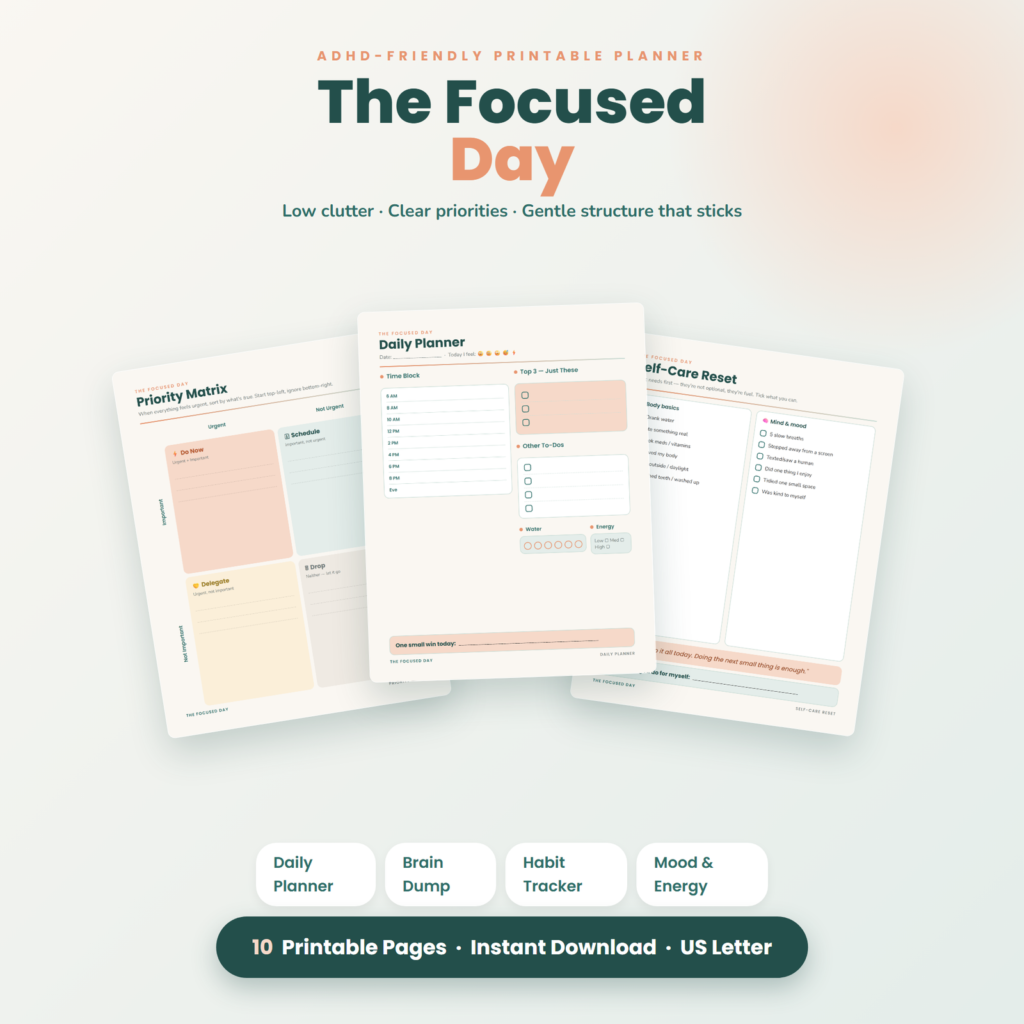
The anchor page of the whole bundle. Instead of an endless to-do column, you pick exactly three things that would make today a success. Below the Top-3 sits a time-blocked schedule so each task gets a concrete home in your day — research on time management consistently shows that “I’ll do it sometime today” is where tasks go to die, while “2:00–2:45” is where they get done. There is also a small “everything else” area for the minor tasks, so they are captured without competing with your three real priorities.
2. Low-Energy Day page
The page most planners forget to include. On days when your battery starts at 20%, opening a full daily spread feels like an accusation. The low-energy page asks almost nothing of you: one tiny win to aim for, basic self-care checkboxes (water, food, meds, fresh air), and a short “it still counts” list that reframes rest and maintenance as legitimate progress. Using this page on a bad day keeps your planning streak alive, which makes it dramatically easier to return to the full page tomorrow.
3. Weekly Overview
A one-page bird’s-eye view of the week: appointments, deadlines, and the two or three outcomes that matter most across the next seven days. Fill it in during your weekly reset (page 13) and glance at it each morning before choosing your daily Top-3. It bridges the gap between “what my month looks like” and “what I’m doing at 10 a.m.”
4. Time Blocking with buffer column
Classic time blocking fails for many people for one simple reason: no margin. One overrun at 9:30 and the whole day’s plan collapses, so the planner gets abandoned. This page adds a dedicated buffer column beside every block — planned transition time between tasks for overruns, context-switching, snacks, and the inevitable “where did my keys go” moments. If you want the full method, our guide to time blocking with buffers walks through it step by step.
5. 4-Quadrant Brain Dump
When your head is full, nothing gets done well. This page gives racing thoughts somewhere to land — split into four quadrants (tasks, worries, ideas, and waiting-on) so the dump is already semi-sorted the moment it leaves your head. Many users keep one beside the bed and one on the desk. Once it’s on paper, your brain can stop rehearsing it.
6. Dopamine Menu
A pre-made list of pick-me-ups organized like a restaurant menu: quick “appetizers” (a song, stretching, stepping outside), main courses (a walk, a hobby session), and “desserts” to enjoy in moderation (the scroll, the snack). The point is deciding in advance how you’d like to recharge, so that in the depleted moment you choose from your own menu instead of defaulting to 45 minutes of doomscrolling that leaves you more drained than before.
7. 31-Day Habit Tracker
A full month of habit tracking on a single page, sized for a realistic number of habits rather than an aspirational wall of them. Checking a box is a micro-reward in itself, and the visible chain builds momentum. Start with one or two habits — our 31-day habit tracker guide explains why starting embarrassingly small is the strategy that actually survives week three.
8. 31-Day Medication Tracker
A simple month-view log for medications or supplements: took it / didn’t, time taken, and a small notes column for anything you want to remember to mention at your next appointment. “Did I already take it today?” is one of the most common daily stressors this bundle’s buyers mention — a paper record answers it in two seconds. (This is a personal logging page only; always follow your prescriber’s guidance.)
9. Cleaning Routines
Housework broken into daily, weekly, and monthly micro-routines so “clean the house” — an unstartable, undefined mega-task — becomes “wipe kitchen counters (5 min).” Checklists remove the deciding step, which is usually the expensive part. Pair it with a timer and the two-minute rule and the baseline of your home quietly rises.
10. Weekly Reset
A guided 20–30 minute Sunday (or any-day) ritual: empty your head with a mini brain dump, review last week without judgment, pick the coming week’s Top-3 outcomes, fill the weekly overview, and set up your daily pages. The weekly reset is the habit that keeps the whole system running — miss a few days and the reset is how you get back on without starting over.
11. Now / Next / Later Priority Matrix
Three columns instead of a ranked list of twenty. “Now” holds only what you are working on today, “Next” is on deck, and “Later” is everything that is allowed to exist without nagging you. Re-sorting takes a minute and instantly answers the paralyzing question, “what should I even be doing right now?”
12–14. Dot-grid notes and companion pages
Matching dot-grid note pages for sketching, lists, meeting notes, or anything that doesn’t fit a template — plus the companion layouts that round out the set so every page shares the same calm, low-visual-noise design language: generous white space, soft structure, and no decorative clutter competing for your attention.
The five design principles behind every page
1. Fewer choices, always. Decision fatigue is the silent killer of planning systems. Every layout in this bundle caps the number of decisions it asks for: three priorities, not ten; three columns, not a ranked list; a short menu of rewards, not “figure out how to relax.” When the page limits the options, starting gets easier.
2. Paper is external memory. Working memory is a leaky bucket for everyone, and more so when attention is stretched. Brain dumps, trackers, and the waiting-on quadrant exist so your head doesn’t have to keep rehearsing open loops. Write it down once; free the mental tab.
3. Margin is part of the plan. The buffer column, the “everything else” catch area, and the undated format all assume the same truth: things overrun, days derail, weeks get skipped. A plan without slack breaks on first contact with reality; a plan with slack bends and survives.
4. Bad days are part of the system, not a failure of it. The low-energy page and the judgment-free weekly reset mean there is always a “smallest viable version” of planning available. Consistency comes from lowering the floor, not raising the ceiling.
5. Calm visuals, on purpose. No neon color blocking, no dense grids, no decorative clutter. Visual noise competes for the same attention you’re trying to protect. The dot-grid aesthetic keeps every page quiet so the only thing that stands out is what you wrote on it — and it keeps ink costs low as a bonus.
Who this bundle is for
- Adults with ADHD or ADHD-style executive function struggles — diagnosed or not, if “I know what to do, I just can’t make myself start” sounds familiar, this system was designed around that exact gap.
- Students juggling classes, deadlines, and a brain that finds everything more interesting than the assignment due tomorrow.
- Parents and caregivers running a household’s worth of invisible tasks who need them externalized onto paper.
- Serial planner-abandoners — people who have quit five planners and blamed themselves five times, when the real problem was rigid planner design.
- Digital planners who annotate PDFs in GoodNotes, Notability, or Xodo and want clean, import-ready templates.
It is not for anyone looking for a dated, pre-filled yearly diary — every page here is undated on purpose, so a skipped week costs you nothing and the bundle never expires.
How to use it: the 15-minute setup
- Download and unzip. Your files arrive instantly after checkout — A4 and US Letter versions of all 14 pages, individually and combined.
- Start with just two pages. Print a week of Top-3 daily pages and one brain dump. Do not print everything on day one — a stack of empty templates is its own kind of pressure.
- Do a brain dump first. Get everything out of your head and into the four quadrants. Then pick tomorrow’s Top-3 from it.
- Add the weekly reset in week two. Once daily pages feel natural, the Sunday reset locks the loop together.
- Layer in trackers as needed. Habit tracker when you’re ready to build one habit; medication tracker if that’s a daily question mark; cleaning routines when the house needs a system.
- Keep the low-energy page visible. It only works if it’s within reach on the day you need it.
The golden rule: a half-used planner is a successful planner. If you use three pages out of fourteen forever, the bundle has done its job. For a deeper dive into building a sustainable ADHD planning routine, read our full guide to ADHD daily planner printables.
Paper sizes, printing and digital compatibility
Every page ships in both A4 (210 × 297 mm) — the standard in Europe, the UK, Australia, and most of the world under ISO 216 — and US Letter (8.5 × 11 in) for the US and Canada. No awkward scaling, no cut-off margins: you print the file made for your paper. Wherever you are, our printable planners by country hub and the North America hub cover regional paper and printing specifics.
| Use case | Print (A4 / US Letter) | Digital (GoodNotes & PDF apps) |
|---|---|---|
| Setup | Print only the pages you need this week | Import PDFs once, duplicate pages forever |
| Best for | Visual reminders you can’t swipe away | Everything in one device, infinite copies |
| Habit & med trackers | Stick on the fridge or mirror | Keep in your daily notebook tab |
| Cost over time | Ink + paper | Zero after purchase |
| Repairing a bad week | Print a fresh page — no ruined notebook | Duplicate a clean template page |
For digital planning, the PDFs import cleanly into GoodNotes, Notability, Noteshelf, Xodo, and any app that annotates PDFs. New to that workflow? Our GoodNotes digital planning guide takes you from import to a working daily notebook in about ten minutes. Printing at home works on any standard inkjet or laser printer; the design is deliberately ink-light (no heavy backgrounds), and it prints beautifully in black and white.
Pairs well with
- ADHD Planner Printable — our original single-planner layout, a lighter starting point if the full 14-page system feels like a lot.
- Gratitude Journal Printable — a two-minute evening page that pairs naturally with the daily planner’s shutdown routine.
- Ultimate Printable Planner Bundle — every planner in the store, one price, if you want the whole toolkit at once.
Learn more before you buy
Want to compare options first? Our roundup of the best printable planners for 2026 puts this bundle side by side with our other planner systems, and the ADHD daily planner printables guide goes deep on how each page type supports focus, routines, and follow-through.
Frequently asked questions
Is this planner dated or undated?
Completely undated. You write the date yourself, which means no wasted pages when life happens, no guilt spiral over a blank March, and no need to re-buy anything in January. Skip a week, come back, keep going — the planner doesn’t keep score.
Do I need an ADHD diagnosis to benefit from this?
Not at all. The pages are built around universal executive-function supports — fewer choices, external memory, visible routines, built-in buffers — that help anyone who struggles with focus, overwhelm, or follow-through. If you have ADHD, the design will feel unusually considerate; if you don’t, it’s simply a very forgiving planner. It is an organizational tool, not a medical product, and it doesn’t replace professional care.
Can I use it on my iPad or tablet?
Yes. All 28 PDFs import directly into GoodNotes, Notability, Noteshelf, and any PDF annotation app on iPad, Android tablets, or a laptop. Duplicate the template pages as often as you like within your personal use. Our GoodNotes guide shows the exact workflow.
What exactly do I receive after purchase?
An instant digital download containing all 14 page designs in both A4 and US Letter (28 individual PDFs), plus combined files for easy batch printing. Nothing physical ships. You can re-download your files any time from your account.
Will it print okay in black and white?
Yes — the layouts use a calm, ink-light design with no heavy color backgrounds, so a standard home printer in grayscale produces clean, fully usable pages. A4 users and US Letter users each get files sized natively for their paper, so nothing shifts or gets cut off.
Can I share the files with a friend or resell them?
The bundle comes with a personal-use license: print and use as many copies as you like for yourself and your own household, on paper or on your devices. Sharing the files, reselling them, or redistributing them (free or paid) isn’t permitted. If a friend would love it, sending them the product link is the kind thing to do.
Instant download & license
This is a digital product: your download links appear immediately after checkout and in your confirmation email — no shipping, no waiting, and you can start planning tonight. All files are for personal use only. Because the product is digital and delivered instantly, all sales are final; if a file ever gives you trouble, contact us and we’ll make it right.
Explore More Digital Tools
- Browse the full shop — planners, trackers, prompt packs and printables
- Free printables library
- Budgeting & saving guide · Planners & productivity guide
- Paper sizes & currency by country
Every Pixquo product is an instant download — no shipping, no waiting.
Reviews
There are no reviews yet.