
Description
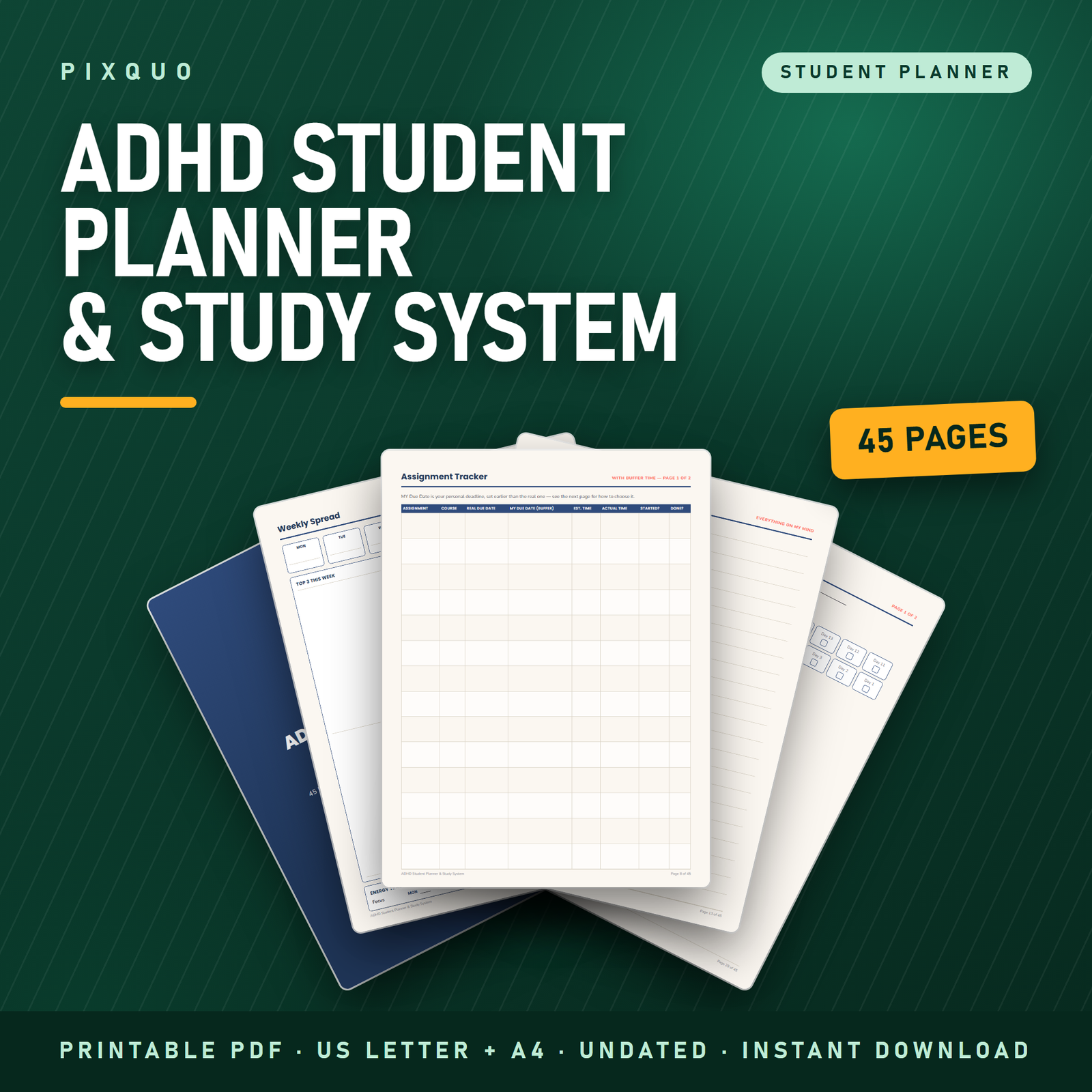
The problem is almost never the deadline. It is the gap between “I know it is due Friday” and actually starting it. This 45-page printable planner is built around that gap. Its centrepiece is an assignment tracker with two date columns — the real due date, and your due date, set deliberately earlier — plus the brain-dump pages, study-block planners and start-a-task ladders that get work moving before the panic does.
It is a practical organisational system, not a lecture. Every page is a working page: you print it, you write on it, it does something. No affirmations, no filler, no colour-in-the-mandala pages padding the count.
What is inside — all 45 pages
Getting started (pages 1–4). Cover, a welcome page explaining how the buffer-date system works, a how-to-print page covering paper, margins, binder and discbound options and the laminate-and-reuse trick, and a terms page.
Semester set-up (pages 5–7). A 16-week semester-at-a-glance grid, a course and class directory for professors, rooms, contacts and office hours, and a weekly class timetable.
The assignment system (pages 8–12). Two full assignment-tracker pages with columns for assignment, course, real due date, MY due date (the buffer), estimated time, actual time, started and done — plus a one-page explainer with a worked example of how to choose a sensible buffer, and two big-project breakdown pages that split one intimidating project into eight sub-steps, each with its own buffer date.
Brain dumps (pages 13–16). Four different layouts because the same format does not work every time: an open dump, a dump-then-sort page (do / defer / delete / delegate), a worry dump paired with a “what is actually in my control” column, and an idea-capture page with an act-on-it-by date so good ideas do not just evaporate.
Weekly rhythm (pages 17–21). A 20-minute weekly reset checklist and four undated weekly spreads with a seven-day overview, top three priorities, assignments due and an energy tracker row.
Daily pages (pages 22–25). Four undated daily study pages: today’s three must-dos, a time-boxed hourly schedule column, a distraction parking lot for everything that pops into your head mid-task, and a done box for wins.
Focus and study blocks (pages 26–28). A study-block planner for six focus blocks with subject, the specific goal for that block, the break and the reward; a focus-session log for tallying sessions, interruptions and what actually helped; and a body-doubling planner for study-with-me sessions.
Exams and revision (pages 29–32). Two exam-countdown pages with a days-to-go grid, topic checklist and confidence rating; a topic confidence audit that turns “I feel behind” into a ranked revisit list; and a revision rotation planner with three spaced review dates per topic.
Reading and lectures (pages 33–36). Two reading-log pages with text, pages, date, key takeaway and a follow-up question column, plus two Cornell-style lecture note pages with cue column, notes area and summary strip.
Executive-function pages (pages 37–41). A daily checklist split into morning, day and evening; a weekly logistics checklist (laundry, bag reset, inbox, admin, recurring appointments); a task starter ladder that breaks a dreaded task into a two-minute first step, then five, then fifteen; a distraction and environment audit; and a seven-day energy and focus tracker for spotting your own patterns.
Wrapping up (pages 42–45). A group-project coordinator, a grade and credit tracker with assessment weightings and a running estimate, a semester wins and what-worked reflection, and a next-semester plan page.
Why the buffer date matters
Most planners give you one due-date column, so the plan and the deadline are the same thing — which means any slip is instantly a crisis. Putting your own earlier date next to the real one does something small and useful: it moves the emotional deadline forward and leaves room for the printer failing, the file not saving, or a day that simply does not go to plan. The explainer page walks you through choosing a buffer that is big enough to help and small enough that you still believe it. It is a scheduling habit, nothing more clever than that — but it is the habit the rest of the planner is built around.
Who this is for
Students who lose time between intending to start and starting: college and university students, sixth-form and high-school students, mature students returning to study, distance and online learners, and anyone juggling coursework with a job. It suits people who find standard dated planners guilt-inducing — because this one is undated, so a skipped week costs you nothing and you can print exactly the pages you need. Parents and study coaches buy it to work through with a student. It is also a reasonable fit for anyone who simply plans badly under pressure, whether or not that has a label attached to it.
How to use it
Print the semester set-up pages once at the start of term and fill in your courses and timetable. Print the assignment tracker and keep it somewhere you physically see it. Then print in small batches: a handful of weekly spreads, a stack of daily pages, brain-dump pages whenever your head is full. Do the 20-minute weekly reset on the same day each week — that single ritual is what keeps the rest of the system alive.
Because it is undated, nothing expires. Print a fresh set next semester, next year, or for a completely different course. A popular approach is to print the reusable pages (brain dump, daily study, study blocks) once, slip them into a plastic sleeve and write on them with a dry-wipe pen; print the trackers and logs on plain paper so you keep the record.
Formats and compatibility
Two print-ready PDF bundles are included: US Letter (8.5 × 11 in) and A4, both 45 pages. You also get all 90 individual page PDFs (45 in each size) so you can print one page fifteen times without wading through the whole file. Print at 100% / actual size, single- or double-sided, on any home or library printer. Everything is designed in vector layout for a clean, sharp print, and it works equally well in a ring binder, a discbound system or a plastic sleeve.
You can also drop the PDFs into GoodNotes, Notability or any tablet annotation app and write on them with a stylus, though the pages are laid out first and foremost for paper.
Pairs well with
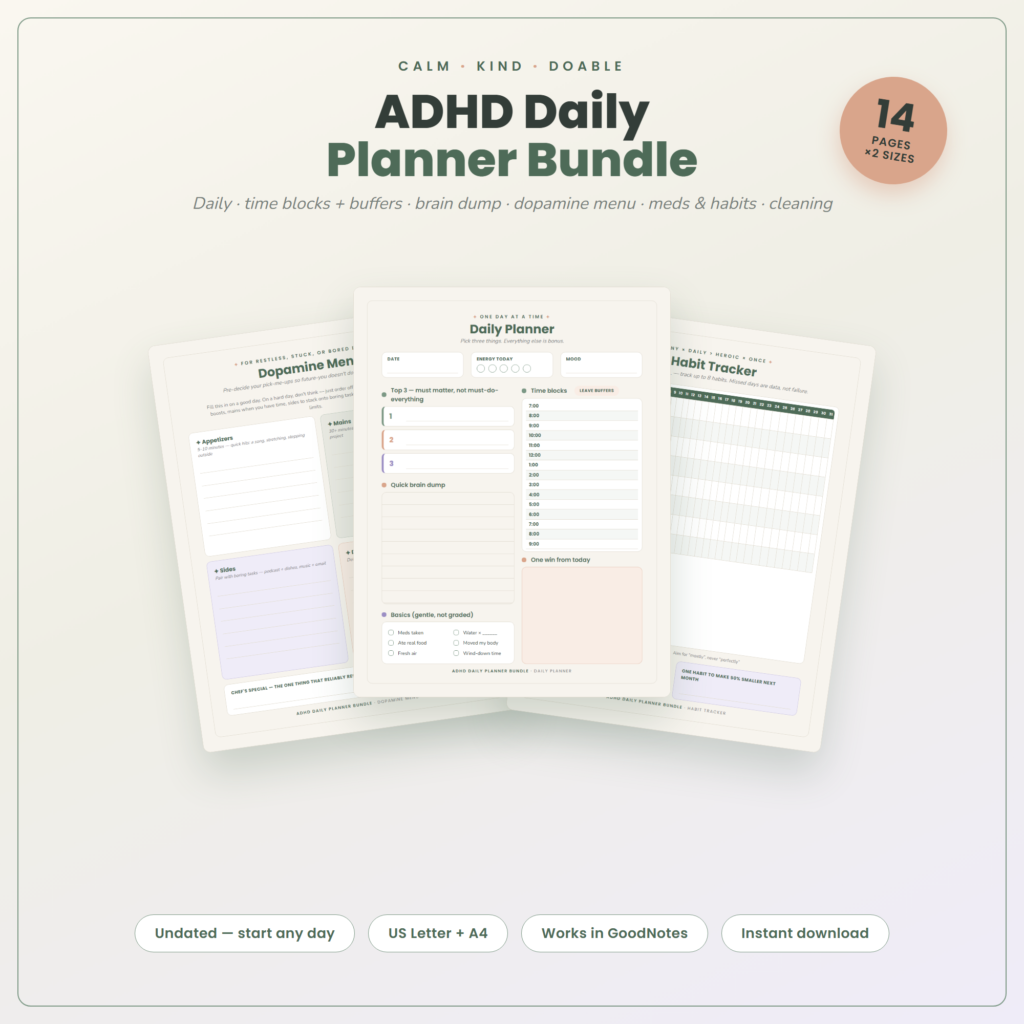
- 14+ Page ADHD Daily Planner Bundle — the everyday, non-student version for life admin, routines and habits outside term time.
- Student Planner Printable — a lighter, more conventional student planner if you want the basics without the executive-function pages.
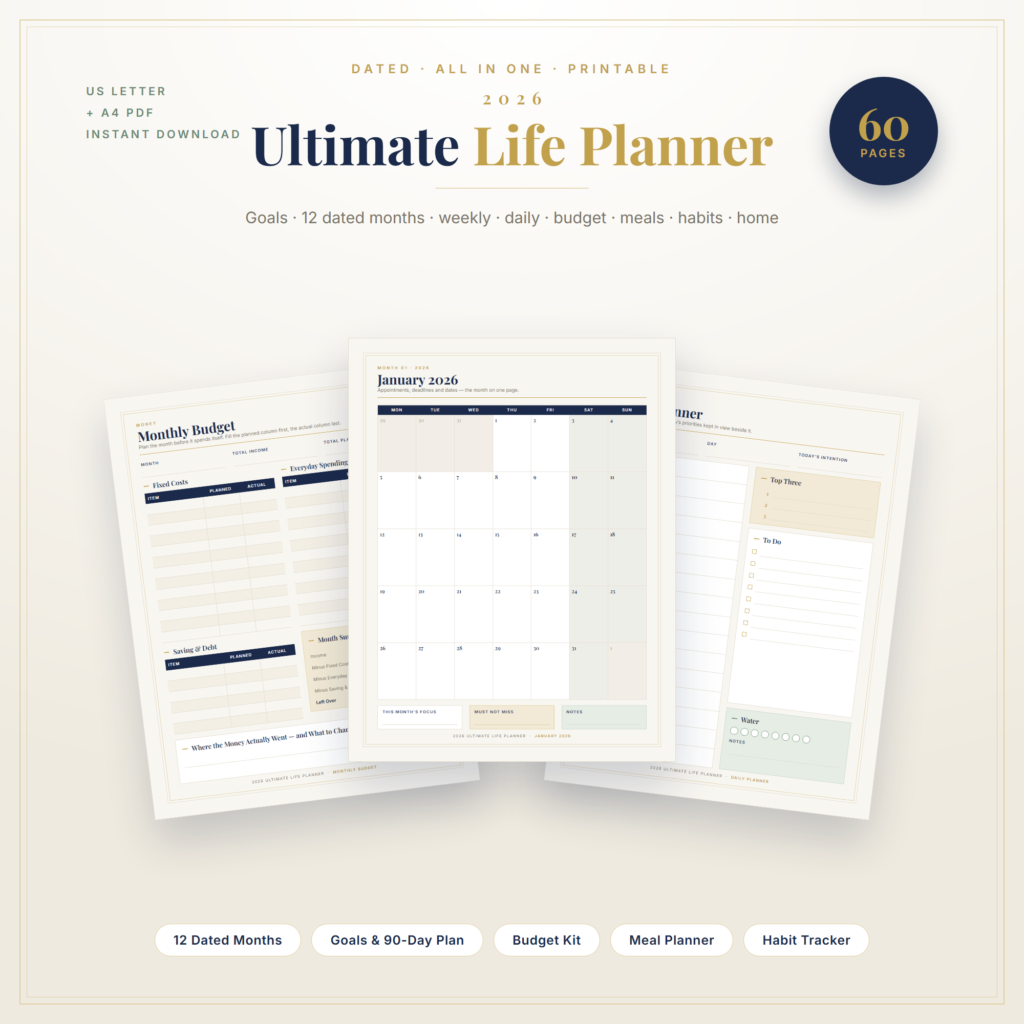
- 2026 Ultimate Life Planner (60 Pages) — a full dated life planner covering goals, budget, meals, habits and home.
Free reading first
Have a look at our guide to planning systems that actually stick and our walkthrough of time blocking, which pairs directly with the study-block planner. You can browse the whole ADHD-friendly printable planner collection too.
Is this planner dated? Will it be out of date next year?
It is completely undated. Weekly and daily pages have blanks for the day and date, the semester grid uses week numbers, and the exam countdowns work from whatever date you write in. Print it in September, print it in February, print it again in three years — it never expires and there is no yearly version to re-buy.
Do I have to print all 45 pages?
No, and you should not. Print the set-up pages once, then print the working pages in small batches as you need them. Every page PDF is supplied individually as well as in the full bundle, so printing fifteen copies of just the daily study page takes one click.
Will this work on an iPad in GoodNotes or Notability?
Yes. Import either PDF into your annotation app and write on the pages with a stylus. Note that the pages are not hyperlinked or tab-navigated like a purpose-built digital planner — they are print-first pages that happen to work well digitally.
US Letter or A4 — which do I need?
Both are included, so you do not have to choose. US Letter is standard in the United States and Canada; A4 is standard almost everywhere else. If your printer disagrees with your file, just open the other one.
Is this a treatment programme or a medical resource?
No. It is a planner and a set of organisational worksheets, nothing more. It contains no clinical content, no assessment, no symptom checklists and no treatment guidance, and it is not a substitute for support from a qualified professional. “ADHD” appears here only as a plain description of who tends to find this style of planning helpful.
Instant download & licence
This is a digital download — your files are available immediately after checkout, with unlimited re-downloads and no expiry. Nothing is posted to you. Licensed for personal use: print as many copies as you like for yourself or your own household. You may not resell, redistribute, share the files, or use them commercially, and they may not be reproduced for a class, school or organisation without a separate licence.
Not medical advice. This planner is an organisational and study tool only. It is not medical, psychological or educational advice, it does not diagnose or treat anything, and it is not a substitute for support from a qualified professional. No academic outcome is promised or implied.
GoodNotes and Notability are trademarks of their respective owners. This product is independent and is not affiliated with, endorsed by or sponsored by them; the names are used descriptively only, to say where the PDFs can also be used.
Explore More Digital Tools
- Browse the full shop — planners, trackers, prompt packs and printables
- Free printables library
- Budgeting & saving guide · Planners & productivity guide
- Paper sizes & currency by country
Every Pixquo product is an instant download — no shipping, no waiting.
Reviews
There are no reviews yet.