Move-In / Move-Out Home Organization Binder 35 Pages | Printable Moving Planner | Checklists, Box Log, Inventory, Utilities | US Letter + A4

Original price was: $24.99.Current price is: $9.99.
  • Instant download — access right after checkout
  • 📱 Works on any device — phone, tablet or computer
  • 🖨 Print at home — A4 & US Letter where applicable
  • 🔒 Secure checkout & unlimited re-downloads

35-page undated printable moving binder: countdown checklists, room inventory, box log, packing labels, utilities and address changes. US Letter + A4.

Description

A move is never one big job. It is a few hundred small ones, spread across a couple of months, and almost all of them are only stressful because they live in your head instead of on paper. Which box has the router in it? Did anyone actually tell the water company? By the second week of packing, the whole thing is being run out of a notes app, three email threads and the back of an envelope.

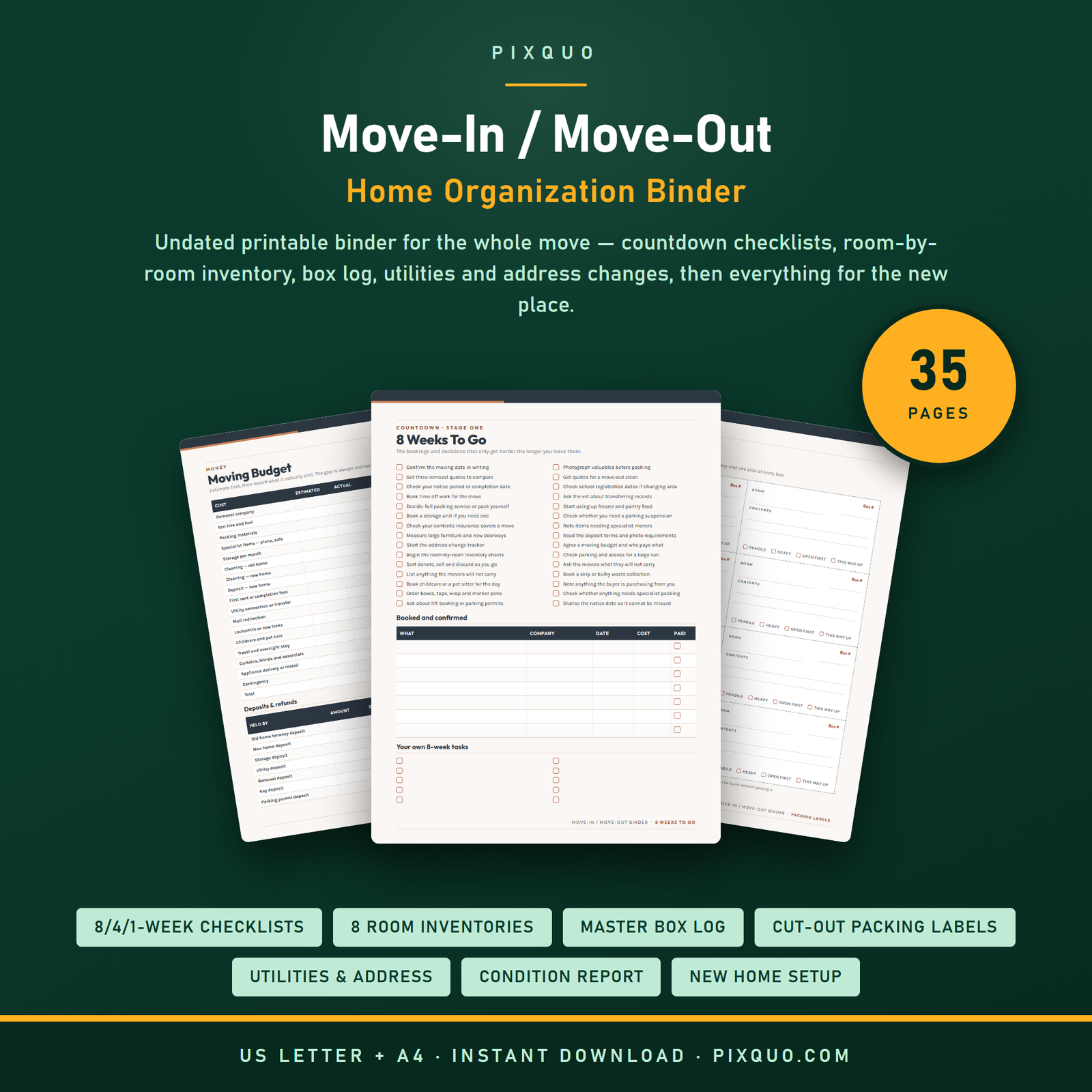
This Move-In / Move-Out Home Organization Binder puts every part of it on one set of pages, in the order the move actually happens. Thirty-five printable pages, completely undated, so it works whether you complete in three weeks or three months, and whether you are a renter chasing a deposit, a first-time buyer, or a family moving a full house across the country.

What’s inside — all 35 pages

Getting set up (pages 1–3). A designed cover, a welcome page carrying full printing instructions, the pages worth printing more than once, an easy to forget list and your personal-use licence, and a binder setup page that splits the whole product into six tabbed sections with a working order for each stage of the move.

The move at a glance (page 4). One sheet holding old address, new address, landlord or agent details at both ends, a key dates countdown covering contracts, keys, packing deadline, moving day and handback, and a moving contacts directory — removal company, van hire, agent, solicitor, both landlords, storage and cleaner. This is the page you photograph and send to everyone helping you.

Countdown checklists (pages 5–9). Five stage checklists with real, specific tasks written into them rather than blank filler lines. 8 weeks out covers the bookings and decisions that only get harder with time — quotes, notice periods, insurance, storage, measuring furniture against new doorways. 4 weeks out moves to notice given in writing, utility transfers, mail redirection, and packing the rooms you rarely use. 1 week out is confirmations, the defrosted freezer, bagged fixings, and the box that stays in the car. Moving day gives you an hour-by-hour timeline, a leaving checklist for the old home, an arrival checklist for the new one, and a meter-reading table for both properties. The first week in covers registrations, safety checks, bin days and the small things that turn an address into a home. Every checklist ends with spare rows for your own additions.

Money (pages 10–11). A moving budget with seventeen pre-labelled cost lines — removals, van hire, materials, storage, cleaning at both ends, deposits, connection fees, locksmith, childcare, contingency — each with estimated, actual, paid and notes columns. Then a deposits and refunds table so money you are owed does not quietly disappear. Page eleven is a three-way removal quote comparison covering price basis, crew size, inclusions, insurance excess, cancellation terms, deposit and availability, with a printed list of questions to put to every company before you sign anything.

Room-by-room inventory (pages 12–19). Eight dedicated inventory sheets — Kitchen, Living Room, Bedrooms, Bathrooms, Home Office, Garage & Shed, Basement & Attic and Outdoor — each with twenty-four rows for item, quantity, condition, box number, value and a photo-taken tick, plus a header for who packed it and when. Each sheet carries its own do not forget line, because the things people leave behind are room-specific: the cupboard above the fridge, the loft hatch, the shelf of jars in the garage, whether the shed is staying or going.

Packing (pages 20, 21 & 24). A master box log with thirty-one numbered lines — box number, room packed from, contents summary, fragile flag, destination room and an open-first tick — so any box can be found without opening it. A genuine cut-and-use packing label sheet: eight labels per page on dashed cut lines, each with a room rule, a box-number rule, two contents lines and tick boxes for fragile, heavy, open first and this way up. And a donate, sell and discard log with twenty-six rows and space for where each route goes, because the cheapest box to move is the one you never pack.

Admin (pages 22, 23, 27 & 28). A utilities checklist covering electricity, gas, water, waste, internet, phone, TV, heating oil, insurance, property tax and alarm monitoring, each with provider, account number, stop or final-read date, start date and confirmation — plus a deposits and final-bills table and an on-the-day routine for readings. An address change tracker with twenty-six pre-labelled organisations across banking, employment, insurance, medical, government, education, subscriptions and deliveries, with separate notified and confirmed columns, because only the second one counts. A condition report with move-in and move-out columns for eighteen elements per room plus a damage and repairs log — useful for renters and equally useful for anyone buying. And a key and access log for keys, fobs and permits, with a deliberately restrained codes table that records only a hint and where the real code is stored: a binder that other people handle during a move is not the place to write an alarm code.

Cleaning (pages 25–26). Two room-by-room cleaning checklists: a move-out clean for the old home — kitchen, bathrooms, bedrooms, living areas, whole house, outside and storage, plus a final walk-through — and a move-in clean built around the easiest clean you will ever do: the one before the furniture arrives.

The new home (pages 29–35). A first-night box planner split into kitchen, bedroom, bathroom and tools-and-documents, with a first-night checklist for the evening itself. A ten-step unpacking order that gets you sleeping, washing and eating before it gets you tidy, plus a room-by-room progress table. A measurements page for rooms, ceilings, doorways, windows and curtain drops, an access table for the front door, hallway, stairs, lift and loft hatch, and a squared furniture placement sketch grid. A home maintenance schedule with monthly, quarterly, seasonal and annual tasks — alarms, filters, gutters, heating service, water heater, drains — at a general homeowner cadence. A local services directory for doctor, dentist, pharmacy, vet, school and trades. A warranty and manual log for twenty-three appliances with model, serial, price, warranty end and where the paperwork lives. And a notes page.

Who it’s for

Renters who want a clear record of condition at both ends of a tenancy. Buyers and first-time homeowners with a completion date and no idea what happens between now and then. Families moving a full house who need one place everybody can look at. Anyone who thinks better on paper than in an app, and anyone who wants to hand a partner or a friend a single page and say “this part is yours.” It also makes a genuinely practical new-home gift.

How to use it

Print the set, put it in a two- or four-ring binder with six tabbed dividers, and follow the section order on page three. Fill in the move overview as soon as your date is set, then start the address-change tracker immediately — it runs longer than anything else in the move. Work backwards through the countdown checklists. Print one inventory sheet per room before you open the first box, and number every box as you seal it, writing that number on the log and on the label at the same moment. Print spare copies of the inventory, box log, label sheet and condition report first — they fill up fastest. Keep the binder in the car on moving day, not on the van.

Formats & what you receive

Two ready-to-print PDF bundles — US Letter (8.5 × 11 in) and A4 (210 × 297 mm) — plus all 35 pages as individual PDFs in both sizes, so you can reprint one grid without printing the whole binder. Print at 100% scale with borderless printing turned off. The design reads perfectly well in greyscale on an ordinary home printer, and 90–120 gsm (24–32 lb) paper stands up best to pens and repeated handling.

Organising more than the move?

Once the boxes are gone, pair this with the Home Management Binder for running the new place, the Ultimate Life Planner for the year around it, or the Wedding Planning Binder if a move and a wedding have landed in the same year. For free guides and starter sheets, browse the home organisation and meal planning collection and the planners and productivity library.

Frequently asked questions

Is this dated to a particular year?

No. Every page is undated. You write your own move date on the overview page and count backwards through the 8-week, 4-week and 1-week checklists, so the binder works for any move date and never expires. If you move again in five years, print it again.

Does it work for renting as well as buying?

Yes. The condition report has separate move-in and move-out columns and a damage log, which is the part renters use most, and the key and access log covers fobs, permits and communal entries. Buyers use the same pages for their own record and lean more on the maintenance schedule, warranty log and measurements pages. The utilities, address-change, budget and packing sections are identical either way.

Will it work outside the US or UK?

The pages are deliberately generic. Utilities, organisations and services are written as roles rather than brand names, currency is never printed, and there are blank rows throughout for anything specific to your country. Local rules on notice periods, deposits, tax registration and waste disposal vary — the binder prompts you to check them rather than telling you what they are.

Can I print only some of the pages?

Yes. Every page is supplied as an individual PDF as well as inside the full bundle, so you can print exactly what you need — and print eight copies of the room inventory without printing anything else.

Is this an editable or fillable file?

No — this is a print-and-write binder designed to be filled in by hand. That is deliberate: the grids, tick boxes and note areas are sized for a pen, and a physical binder is far easier to carry around a half-empty house, hand to a helper, or photograph and send to a removal crew than a shared file.

Licence & instant download

This is a digital product. Your files are available to download immediately after purchase — nothing is posted to you and there are no shipping costs. Because the files are delivered instantly, this purchase is non-refundable; please check that your printer handles US Letter or A4 before buying. Licensed for personal, single-household use: print as many copies as you need for your own move and share printed pages with the people helping you, but do not resell, share or redistribute the files, sell printed copies, or use the design inside another product. The checklists and schedules are general organisational prompts, not legal, financial, insurance or tenancy advice — always check your own lease, contracts and local rules.

Explore More Digital Tools

Every Pixquo product is an instant download — no shipping, no waiting.
Reviews

There are no reviews yet.

Be the first to review “Move-In / Move-Out Home Organization Binder 35 Pages | Printable Moving Planner | Checklists, Box Log, Inventory, Utilities | US Letter + A4”

Your email address will not be published. Required fields are marked *

Product Details

A move is never one big job. It is a few hundred small ones, spread across a couple of months, and almost all of them are only stressful because they live in your head instead of on paper. Which box has the router in it? Did anyone actually tell the water company? By the second week of packing, the whole thing is being run out of a notes app, three email threads and the back of an envelope.

This Move-In / Move-Out Home Organization Binder puts every part of it on one set of pages, in the order the move actually happens. Thirty-five printable pages, completely undated, so it works whether you complete in three weeks or three months, and whether you are a renter chasing a deposit, a first-time buyer, or a family moving a full house across the country.

What's inside — all 35 pages

Getting set up (pages 1–3). A designed cover, a welcome page carrying full printing instructions, the pages worth printing more than once, an easy to forget list and your personal-use licence, and a binder setup page that splits the whole product into six tabbed sections with a working order for each stage of the move.

The move at a glance (page 4). One sheet holding old address, new address, landlord or agent details at both ends, a key dates countdown covering contracts, keys, packing deadline, moving day and handback, and a moving contacts directory — removal company, van hire, agent, solicitor, both landlords, storage and cleaner. This is the page you photograph and send to everyone helping you.

Countdown checklists (pages 5–9). Five stage checklists with real, specific tasks written into them rather than blank filler lines. 8 weeks out covers the bookings and decisions that only get harder with time — quotes, notice periods, insurance, storage, measuring furniture against new doorways. 4 weeks out moves to notice given in writing, utility transfers, mail redirection, and packing the rooms you rarely use. 1 week out is confirmations, the defrosted freezer, bagged fixings, and the box that stays in the car. Moving day gives you an hour-by-hour timeline, a leaving checklist for the old home, an arrival checklist for the new one, and a meter-reading table for both properties. The first week in covers registrations, safety checks, bin days and the small things that turn an address into a home. Every checklist ends with spare rows for your own additions.

Money (pages 10–11). A moving budget with seventeen pre-labelled cost lines — removals, van hire, materials, storage, cleaning at both ends, deposits, connection fees, locksmith, childcare, contingency — each with estimated, actual, paid and notes columns. Then a deposits and refunds table so money you are owed does not quietly disappear. Page eleven is a three-way removal quote comparison covering price basis, crew size, inclusions, insurance excess, cancellation terms, deposit and availability, with a printed list of questions to put to every company before you sign anything.

Room-by-room inventory (pages 12–19). Eight dedicated inventory sheets — Kitchen, Living Room, Bedrooms, Bathrooms, Home Office, Garage & Shed, Basement & Attic and Outdoor — each with twenty-four rows for item, quantity, condition, box number, value and a photo-taken tick, plus a header for who packed it and when. Each sheet carries its own do not forget line, because the things people leave behind are room-specific: the cupboard above the fridge, the loft hatch, the shelf of jars in the garage, whether the shed is staying or going.

Packing (pages 20, 21 & 24). A master box log with thirty-one numbered lines — box number, room packed from, contents summary, fragile flag, destination room and an open-first tick — so any box can be found without opening it. A genuine cut-and-use packing label sheet: eight labels per page on dashed cut lines, each with a room rule, a box-number rule, two contents lines and tick boxes for fragile, heavy, open first and this way up. And a donate, sell and discard log with twenty-six rows and space for where each route goes, because the cheapest box to move is the one you never pack.

Admin (pages 22, 23, 27 & 28). A utilities checklist covering electricity, gas, water, waste, internet, phone, TV, heating oil, insurance, property tax and alarm monitoring, each with provider, account number, stop or final-read date, start date and confirmation — plus a deposits and final-bills table and an on-the-day routine for readings. An address change tracker with twenty-six pre-labelled organisations across banking, employment, insurance, medical, government, education, subscriptions and deliveries, with separate notified and confirmed columns, because only the second one counts. A condition report with move-in and move-out columns for eighteen elements per room plus a damage and repairs log — useful for renters and equally useful for anyone buying. And a key and access log for keys, fobs and permits, with a deliberately restrained codes table that records only a hint and where the real code is stored: a binder that other people handle during a move is not the place to write an alarm code.

Cleaning (pages 25–26). Two room-by-room cleaning checklists: a move-out clean for the old home — kitchen, bathrooms, bedrooms, living areas, whole house, outside and storage, plus a final walk-through — and a move-in clean built around the easiest clean you will ever do: the one before the furniture arrives.

The new home (pages 29–35). A first-night box planner split into kitchen, bedroom, bathroom and tools-and-documents, with a first-night checklist for the evening itself. A ten-step unpacking order that gets you sleeping, washing and eating before it gets you tidy, plus a room-by-room progress table. A measurements page for rooms, ceilings, doorways, windows and curtain drops, an access table for the front door, hallway, stairs, lift and loft hatch, and a squared furniture placement sketch grid. A home maintenance schedule with monthly, quarterly, seasonal and annual tasks — alarms, filters, gutters, heating service, water heater, drains — at a general homeowner cadence. A local services directory for doctor, dentist, pharmacy, vet, school and trades. A warranty and manual log for twenty-three appliances with model, serial, price, warranty end and where the paperwork lives. And a notes page.

Who it's for

Renters who want a clear record of condition at both ends of a tenancy. Buyers and first-time homeowners with a completion date and no idea what happens between now and then. Families moving a full house who need one place everybody can look at. Anyone who thinks better on paper than in an app, and anyone who wants to hand a partner or a friend a single page and say “this part is yours.” It also makes a genuinely practical new-home gift.

How to use it

Print the set, put it in a two- or four-ring binder with six tabbed dividers, and follow the section order on page three. Fill in the move overview as soon as your date is set, then start the address-change tracker immediately — it runs longer than anything else in the move. Work backwards through the countdown checklists. Print one inventory sheet per room before you open the first box, and number every box as you seal it, writing that number on the log and on the label at the same moment. Print spare copies of the inventory, box log, label sheet and condition report first — they fill up fastest. Keep the binder in the car on moving day, not on the van.

Formats & what you receive

Two ready-to-print PDF bundles — US Letter (8.5 × 11 in) and A4 (210 × 297 mm) — plus all 35 pages as individual PDFs in both sizes, so you can reprint one grid without printing the whole binder. Print at 100% scale with borderless printing turned off. The design reads perfectly well in greyscale on an ordinary home printer, and 90–120 gsm (24–32 lb) paper stands up best to pens and repeated handling.

Organising more than the move?

Once the boxes are gone, pair this with the Home Management Binder for running the new place, the Ultimate Life Planner for the year around it, or the Wedding Planning Binder if a move and a wedding have landed in the same year. For free guides and starter sheets, browse the home organisation and meal planning collection and the planners and productivity library.

Frequently asked questions

Is this dated to a particular year?

No. Every page is undated. You write your own move date on the overview page and count backwards through the 8-week, 4-week and 1-week checklists, so the binder works for any move date and never expires. If you move again in five years, print it again.

Does it work for renting as well as buying?

Yes. The condition report has separate move-in and move-out columns and a damage log, which is the part renters use most, and the key and access log covers fobs, permits and communal entries. Buyers use the same pages for their own record and lean more on the maintenance schedule, warranty log and measurements pages. The utilities, address-change, budget and packing sections are identical either way.

Will it work outside the US or UK?

The pages are deliberately generic. Utilities, organisations and services are written as roles rather than brand names, currency is never printed, and there are blank rows throughout for anything specific to your country. Local rules on notice periods, deposits, tax registration and waste disposal vary — the binder prompts you to check them rather than telling you what they are.

Can I print only some of the pages?

Yes. Every page is supplied as an individual PDF as well as inside the full bundle, so you can print exactly what you need — and print eight copies of the room inventory without printing anything else.

Is this an editable or fillable file?

No — this is a print-and-write binder designed to be filled in by hand. That is deliberate: the grids, tick boxes and note areas are sized for a pen, and a physical binder is far easier to carry around a half-empty house, hand to a helper, or photograph and send to a removal crew than a shared file.

Licence & instant download

This is a digital product. Your files are available to download immediately after purchase — nothing is posted to you and there are no shipping costs. Because the files are delivered instantly, this purchase is non-refundable; please check that your printer handles US Letter or A4 before buying. Licensed for personal, single-household use: print as many copies as you need for your own move and share printed pages with the people helping you, but do not resell, share or redistribute the files, sell printed copies, or use the design inside another product. The checklists and schedules are general organisational prompts, not legal, financial, insurance or tenancy advice — always check your own lease, contracts and local rules.