
Description
Most small businesses are not run badly. They are run in seven places at once. Income lives in a bank app. Expenses live in a shoebox, a photo roll and a card statement. Invoices live in whatever document you copied from the last invoice. The tax number lives in a feeling of dread rather than a cell. The plan for the year lives in your head, and the version of your CV you would need if this all went sideways was last updated when you still had a manager.
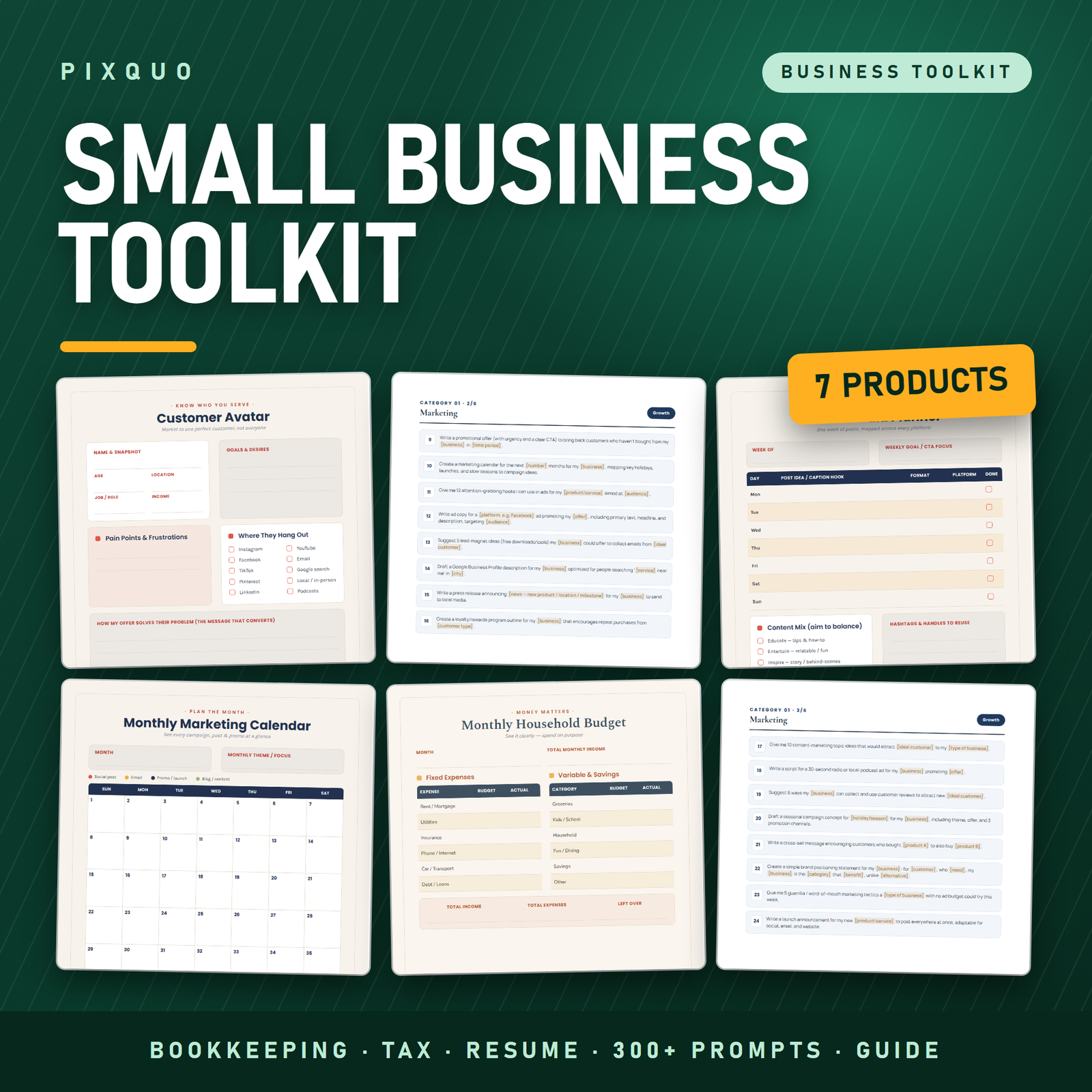
None of that is a discipline problem. It is a tooling problem, and it is the specific problem this toolkit is built for. Seven attached files: three spreadsheets that hold the money, one printed planner that holds the strategy, one resume and cover-letter pack for the version of your life that runs alongside the business, one 300-prompt AI library for the writing and marketing work, and one short ebook on building income that does not require your presence. One download, one folder, no subscriptions.
Who this is genuinely for. Sole traders and freelancers in year one to year three, past the hobby stage and not yet at the accountant-on-retainer stage. Side-hustlers whose “bit of fun” has started generating enough income to attract tax questions. Consultants, coaches, designers, VAs and trades who invoice a handful of clients a month and need to know, without a two-hour reconciliation, whether this month was actually good. People leaving employment who need business systems and a current CV at the same time, because the sensible version of going solo keeps one foot on the ground.
Who it is not for. If you already run Xero, QuickBooks or Wave and it works, the three spreadsheets here will feel like a step backwards — buy the prompt pack or the planner on their own instead. If you have inventory, payroll, or multiple entities, you have outgrown spreadsheets and should say so out loud. And if you want a done-for-you business, this is not that; every file here is a structure you have to fill in.
Everything included
Seven files are attached to this product: three Excel workbooks, two PDFs, one PDF ebook and one .zip archive. Every one of them is also sold separately, and every one is linked below so you can inspect it before buying. Nothing on this page is a placeholder for something arriving later.
The money layer — three spreadsheets
- Small Business Bookkeeping Tracker — the general ledger of the set. Categorised income and expense entry with running totals, so at any point in the year you can answer “what have I actually made” without opening a bank app. This is the file you touch weekly, and the one that makes the other two useful.
- Small Business Tax & Expense Tracker — the deductions side, kept deliberately separate from the ledger because the questions are different. What is claimable, what percentage of a mixed personal-and-business cost belongs to the business, and what the running set-aside should be. The purpose of this file is that tax time becomes a lookup instead of an archaeology project.
- Freelancer Invoice & Income Tracker — the receivables side. Which invoices are out, which are late, which client is quietly funding most of your year, and what is actually collected versus merely billed. If you have ever been surprised by a cash gap in a month with good revenue, this is the file that would have shown it coming.
The plan layer
- Boss Mode Small Business Planner (printable) — a printable planner covering business goals, income targets, marketing planning and the weekly and monthly review pages that keep a solo business from drifting. Deliberately paper. Some of this thinking simply does not happen in a spreadsheet, and a printed page you have to look at on the desk beats a tab you can close.
The writing and marketing layer
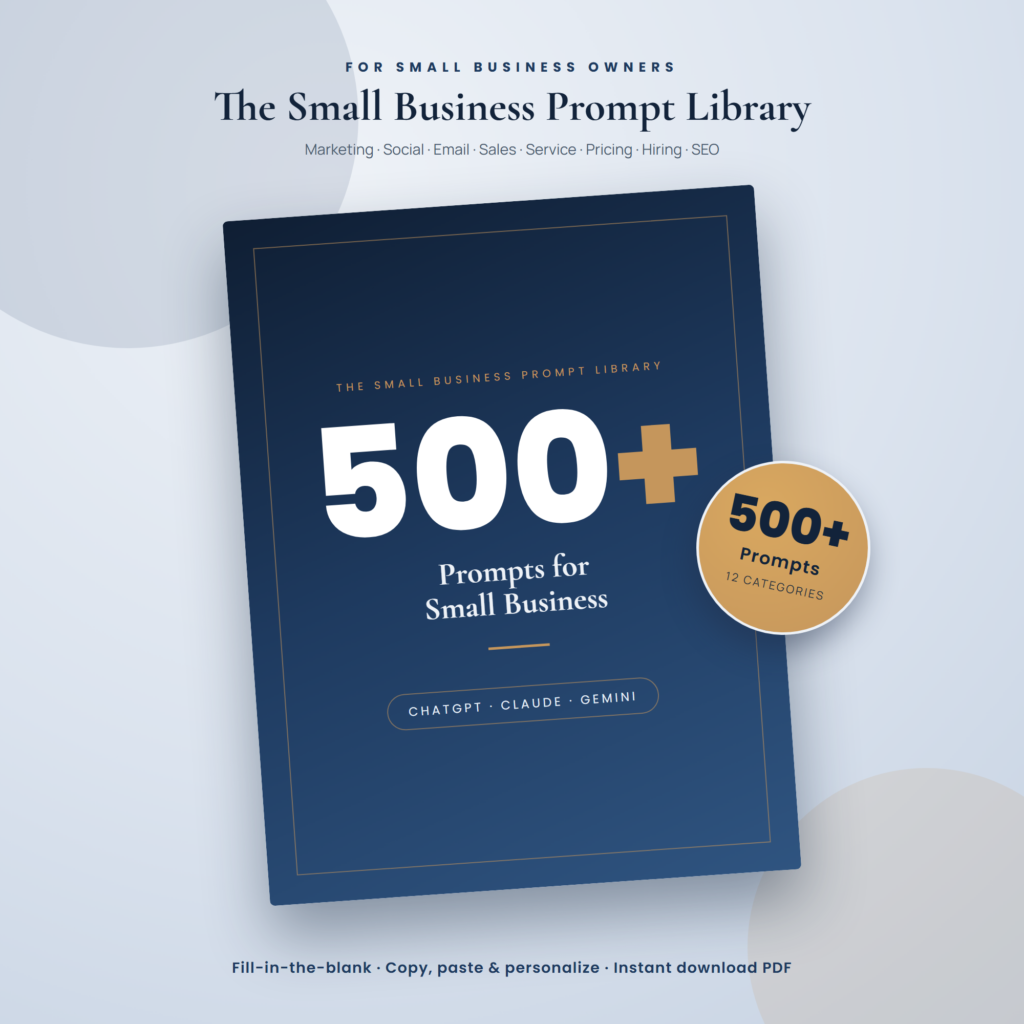
- 300+ ChatGPT Prompts for Small Business — a prompt library aimed at the writing jobs that quietly eat a solo operator’s week: sales pages, service descriptions, client emails, proposals, social captions, follow-ups, objection handling, offer positioning. Each prompt uses bracketed variables you replace with your own business, offer and audience. It is a PDF you copy from — no login, no plugin, no dependency on any one AI provider.
The career and income layer
- Modern ATS Resume & CV Pack (with Cover Letter) — editable resume and cover-letter templates built to survive applicant tracking system parsing rather than to look clever in a design portfolio. It sits in a small-business toolkit for a reason that nobody likes to say out loud: a large share of new businesses run alongside employment, or need to, and the people who cope best with a slow quarter are the ones whose CV is already current. Delivered as a .zip of the template files.
- The Passive Income Playbook — a short ebook on structuring income streams that do not consume an hour of your time per unit sold. Read it as a thinking tool for what to build next rather than as a get-rich blueprint. It is the shortest file here and the one most likely to change what you do rather than how you record it.
What this costs versus buying them one at a time
Here is the arithmetic, computed from today’s listed catalogue prices, with nothing inflated.
All seven files are listed individually. Their prices are $10.76 (bookkeeping tracker), $10.76 (tax and expense tracker), $10.76 (invoice and income tracker), $11.84 (Boss Mode planner), $10.76 (ATS resume pack), $13.46 (300+ small business prompts) and $6.97 (Passive Income Playbook). That totals $75.31.
That $75.31 is the real number. It is not a “value” figure built from prices nobody has ever paid, and there is no crossed-out fantasy total on this page. Compare $75.31 to the price displayed above and make the decision from that comparison alone. If the listed price is comfortably below $75.31, the bundle is worth taking. If it is not, buy the three or four files you will genuinely open and skip the rest — that is a legitimate outcome and this page is not going to argue you out of it.
The more useful question is which files you would have bought anyway. Most solo operators who reach this page need the bookkeeping tracker and the tax tracker, full stop. The invoice tracker matters if you bill clients rather than sell products. The planner matters if your problem is drift rather than admin. The resume pack matters to about half of buyers and not at all to the other half. Be honest with yourself about which half you are in before you decide.
Which part suits which situation
The freelancer who keeps getting surprised by tax. This is the most common case, and the fix is two files. Set up the bookkeeping tracker with your real categories, then run every expense through the tax and expense tracker with an honest business-use percentage. Within one month you will have a set-aside figure you can actually transfer to a separate account. The surprise disappears not because you earned differently but because you finally have a running number instead of an annual reveal.
The consultant with lumpy cash flow. The invoice and income tracker is the one that matters. Revenue is not the problem; timing is. Once you can see which invoices are thirty days out and which client is habitually late, you can stop treating “we had a good month” and “we got paid” as the same event.
The side-hustler crossing the line into “this is a business”. You need the bookkeeping tracker first — retroactively reconstructing a year of a side business is genuinely miserable, and the earlier you start recording, the smaller that job is. The Passive Income Playbook is the right second file, because at this stage the strategic question is whether the thing you are building scales without you.
The person leaving employment this year. Take the whole set. The planner forces you to write down what the first twelve months actually look like, the spreadsheets mean you start with records instead of resolving to start later, the prompt pack covers the marketing writing you have never had to do before, and the ATS resume pack keeps your options open. Nobody regrets a current CV.
The established small business with an accountant. You probably want the prompt pack and the planner and nothing else. Your accountant has opinions about your bookkeeping, and those opinions beat any spreadsheet on this page.
Your first week
Day 1 — download and open everything (20 minutes). Put all seven files in one folder, in cloud storage if you have it, so the spreadsheets are backed up automatically. Open each one once. Do not start entering data.
Day 2 — set your categories (40 minutes). Open the bookkeeping tracker and edit the expense categories to match how your business actually spends money, not how a generic template thinks it does. This is the single highest-value thirty minutes in the whole week, because categories you invented are categories you will keep using.
Day 3 — enter one real month (45 minutes). Pick the most recent complete month, open your bank statement, and enter every line. One month, not the year. You need a working example more than you need completeness, and completeness will feel possible once you have done one.
Day 4 — the tax set-aside (30 minutes). Move that month’s expenses into the tax and expense tracker, assign honest business-use percentages to anything mixed, and read off the set-aside figure. Then actually transfer that amount into a separate savings account. The file is only useful if it changes where the money sits.
Day 5 — invoices (30 minutes). Load every outstanding invoice into the invoice and income tracker, including the awkward one you have been avoiding. Then send one chase email — the prompt pack has the phrasing if you find that email hard to write, which most people do.
Day 6 — plan on paper (45 minutes). Print the goals, income-target and marketing pages from the Boss Mode planner and fill them in with a pen. Twelve-month target, three offers, one marketing channel you will actually do. Pin it somewhere you will see it.
Day 7 — one AI prompt and one chapter (30 minutes). Run a single prompt from the small business pack against a real piece of writing you owe someone. Then read one section of the Passive Income Playbook and write down one idea from it. Stop there. A system you can sustain beats a system you completed once.
Formats, compatibility and delivery
Three of the files are Excel workbooks (.xlsx). They open in Microsoft Excel, and they can be imported into Google Sheets via File → Import, which is how most people will use them. Formulas are standard spreadsheet functions with no macros and no add-ons, so nothing will be blocked by your security settings and nothing breaks if you change a column.
The Boss Mode planner, the prompt pack and the Passive Income Playbook are PDFs. The planner is designed to be printed on a normal home or office printer; the prompt pack and the ebook are meant to be read on screen and copied from. The resume pack arrives as a .zip archive containing the template files — unzip it before opening.
Everything is yours to keep. There is no subscription, no seat licence, no account to maintain, and no file that expires. Delivery is instant: a download link on the confirmation page and in your email.
Frequently asked questions
Is this worth it if I only want the bookkeeping and tax spreadsheets?
Those two on their own are $21.52. If that is genuinely all you want, buy those two. The bundle earns its place when you would use four or more of the files, and the honest total above is printed so you can make exactly this calculation rather than take a marketing claim on trust.
There is another bookkeeping spreadsheet in this shop. Which one do I need?
Awkward but fair. The Small Business Bookkeeping & Tax Spreadsheet is a newer, single-workbook build that combines income, expenses, invoicing and mileage with a profit-and-loss dashboard. It is not included in this toolkit. If you would prefer one consolidated workbook with a dashboard over three focused ones, buy that instead — it may suit you better, and pretending otherwise would be a poor way to earn your money. The three trackers here suit people who like their ledger, their tax file and their receivables kept apart.
Why is a resume pack in a small business toolkit?
Because a large share of new businesses run alongside a job, or need to at some point, and the people who handle a bad quarter best are the ones whose CV is already current. If that logic does not apply to you, treat it as a file you did not need — but the honest component total above includes its $10.76, so it is priced in rather than presented as a bonus.
Will these spreadsheets work for my country’s tax rules?
They are general-purpose trackers, not tax software, and they are not tied to any one jurisdiction’s rules, rates or filing forms. You set your own categories and your own set-aside percentage. Nothing here calculates VAT, GST, self-assessment or any national filing for you, and nothing here is tax advice. What they give you is clean, categorised records — which is what an accountant actually wants from you, in any country.
Do I need to know accounting?
No. If you can type a date, an amount and pick a category from a list, you can run all three spreadsheets. The formulas are already written; you fill in rows. What the files assume is consistency, not expertise — five minutes a week beats four hours in March.
Do I need a paid ChatGPT subscription?
No. The prompts are plain text and work in the free tiers of ChatGPT, Claude, Gemini and most other assistants. Paid tiers usually produce better long-form output, but nothing in the pack requires one and nothing stops working without one.
What is the refund position on a digital purchase?
Files are delivered instantly and cannot be returned once downloaded, so treat the sale as final. That is precisely why every file is named, linked to its own listing, and priced openly on this page — inspect anything you are unsure about before you buy. Anything beyond that is governed by the store’s published terms rather than by this description.
Can I use these templates for client work or resell them?
Use them in your own business as much as you like. Reselling the files, distributing them, or repackaging them as your own product is not something this page grants permission for. If you want to build a business selling digital templates, that is a different project and needs a licence this listing does not provide — check the store’s terms before you do anything commercial with the files themselves.
Do I get future additions to this toolkit for free?
No. You are buying the seven files listed on this page as they exist today. New products added to the catalogue later are sold separately. Perpetual-free-updates promises on one-off digital purchases are usually quietly broken, so one is not being made here.
Where to go from here
The short version: seven real files covering money, planning, marketing writing, career cover and income strategy, with a genuine component total of $75.31 at today’s listed prices. Measure that against the price above, decide honestly how many of the seven you would open in the next ninety days, and buy accordingly.
If you want to compare before deciding, look at the Finance Command Center Bundle if spreadsheets are your main need, the Creator & AI Business Bundle if prompts and business systems are, or browse budgeting & finance, bundles and the full shop. Whatever you choose, delivery is instant — you can have your first month of books entered tonight.
Explore More Digital Tools
- Browse the full shop — planners, trackers, prompt packs and printables
- Free printables library
- Budgeting & saving guide · Planners & productivity guide
- Paper sizes & currency by country
Every Pixquo product is an instant download — no shipping, no waiting.

Reviews
There are no reviews yet.