

Description
See your whole financial picture. Track assets, liabilities, net worth over time, and progress toward your money goals with an auto-updating dashboard. Works in Excel and Google Sheets. Instant download.
Your bank balance is a snapshot of one pocket. Your budget is a story about one month. Neither answers the question that actually matters over a lifetime: are you, on the whole, moving forward? Net worth — everything you own minus everything you owe — is the single number that answers it, and this tracker makes calculating, recording, and watching that number a fifteen-minute quarterly ritual instead of a once-a-decade guess. List your assets, list your debts, and the spreadsheet does the arithmetic, keeps the history, charts the trend, and lines it all up against the goals you’re working toward.
Why net worth is the number worth tracking
As Investopedia’s definition of net worth puts it, net worth is the value of assets minus liabilities — the most complete single measure of financial position there is. It’s honest in a way no other number manages. Income can look impressive while debt quietly grows faster. A budget can balance beautifully in a month where the car loan barely moved. Net worth catches all of it, because everything you do with money eventually lands on one side of the ledger or the other: saving raises it, debt paydown raises it, borrowing to consume lowers it, and it doesn’t care how any of it felt at the time.
Tracking it over time matters more than any single reading. A net worth of any size is just a fact; a net worth that’s higher than last quarter is a direction. People who measure the number regularly get something powerful in return: early feedback. A quarter where the trend dips is a prompt to look — was it the market, a one-off expense, or creeping debt? — while the years-long upward line is the most motivating financial chart you’ll ever own, precisely because you built every data point of it.
What’s inside the tracker
Assets: everything you own, organized
A structured place to list what you own by category: cash and checking, savings, retirement and investment accounts, property, vehicles, and anything else of meaningful value. Each asset gets its own row with its current value — you update the numbers, the tracker handles every total. Categorizing matters more than people expect: seeing your split between liquid savings and long-term assets tells you things a single lump figure can’t, like whether an emergency would force you to sell something at a bad time. (On that subject, the CFPB’s guide to building an emergency fund is a great companion read while you set up your savings rows.)
Liabilities: every debt, faced honestly
The half of the picture people avoid — and the half where the fastest progress usually hides. Mortgage, car loans, student loans, credit cards, personal loans: each gets a row with its current balance. Nobody enjoys typing these numbers the first time. But here’s what buyers of this tracker consistently discover: writing the debts down shrinks them psychologically. A vague cloud of “we owe a lot” becomes a finite list with balances that go down when you push on them — and watching a liability row hit zero is a genuine life highlight.
Net worth over time: your trend line
Every time you update the tracker, your net worth is calculated automatically — assets minus liabilities — and recorded as a point in your history. Over months and years this builds the chart that makes the whole habit worthwhile: your personal wealth trend line. Monthly updaters get a finer-grained line; quarterly updaters get a calmer one that ignores noise. Either way, the direction of that line is the truest report card your finances will ever produce, and it updates itself from numbers you were entering anyway.
Financial goals: targets with progress you can see
Alongside the balance sheet lives the goals section: define what you’re aiming for — an emergency fund milestone, a down payment, a debt-free date, a first investment target — and track progress toward each one as your numbers update. Goals transform the tracker from a passive scoreboard into an active plan. There’s a meaningful psychological difference between “saving is good” and “we’re 64% of the way to the house deposit,” and this sheet is built to keep you on the second, far more motivating side of that line.
The auto-updating dashboard
The front page of your financial life: total assets, total liabilities, current net worth, change over time, and goal progress — all pulled automatically from the sheets you fill in. No formulas to maintain, nothing to rebuild. Open the file, and the state of your whole picture is right there. It’s the tab to open when you’re deciding whether you can afford something big, when you’re having the annual money conversation with a partner, or when you just need proof that the boring good habits are working.
Four insights hiding inside your net worth
Once your assets and liabilities live in one structured file, several second-order insights come free — numbers most people have never seen about their own finances:
- Your asset mix. How much of what you own is cash, how much is long-term investments, how much is locked up in property and vehicles? A household with plenty of assets but almost no liquid savings has a very different risk profile from one with the same total spread evenly — and the category totals show you which one you are at a glance.
- Your debt-to-asset picture. Seeing total liabilities next to total assets tells you how leveraged your life is. Watching that relationship improve quarter by quarter — debts shrinking while assets grow — is the structural progress that single account balances can never show.
- Your quarter-over-quarter change. The delta between updates is your household’s true “bottom line” for the period — the net result of every raise, purchase, payment, and market move. Many users find this single figure becomes the headline of their money check-ins.
- Where the movement comes from. Because you update line by line, you can see which rows drove a change: the quarter net worth jumped because the loan crossed below a milestone, or dipped because the car’s value was updated honestly. Understanding the “why” behind the number is what turns tracking into better decisions.
Milestones worth watching for
Net worth progress comes with natural milestones, and the tracker makes each one visible the quarter it happens: the first update where the number is less negative than the last; the crossing into positive territory; the first time liquid savings could cover a month of expenses, then three, then six; the update where a whole liability row disappears; the quarter where assets grow by more than you deposited, because compounding has started doing some of the lifting. None of these show up in a checking account balance — all of them show up here. Give yourself permission to celebrate them; the ritual is half the reason the habit sticks.
Who this tracker is for
- Anyone who has never once calculated their net worth. The first calculation is the hardest and most valuable one — this file makes it a guided exercise instead of a blank page.
- Debt-payoff households who want to see the effort show up somewhere. Budgets show the sacrifice; net worth shows the reward.
- Couples aligning on money. One shared file, one honest picture, dramatically better conversations than two mental models arguing in the kitchen.
- Savers and early investors who want their scattered accounts — bank here, retirement there, brokerage somewhere else — rolled into one coherent story.
- Goal-driven planners working toward a deposit, a sabbatical, or financial independence, who want the milestone math visible every time they check in.
It is not an investment-advice tool and doesn’t tell you what to buy or sell — it’s a measurement instrument. What you do with the clarity is up to you (and, for big decisions, your qualified advisor).
How to use it: the first fill-in and the quarterly ritual
- Gather your balances (20–30 minutes, once). Log into your accounts — bank, retirement, loans, cards — and collect current figures. For property and vehicles, a realistic estimate is fine; consistency matters more than precision.
- Fill the assets and liabilities sheets. One row per account or item, values in, categories chosen. The dashboard assembles itself as you type.
- Meet your number. Whatever it is — large, small, or negative — it’s your starting point, not your verdict. Plenty of financially healthy people started with a negative net worth and a student loan; the trend is the story.
- Set two or three goals. Not ten. An emergency fund target and one debt or savings milestone is a perfect start.
- Put a repeating date in your calendar. Monthly or quarterly — updates take ten to fifteen minutes because the structure already exists. This small ritual is the entire maintenance cost of always knowing where you stand.
For a full walkthrough with worked examples — what counts as an asset, how to value a car, how often to update — read our companion guide, how to track your net worth.
Two principles keep the data honest over the years. First, value things conservatively and consistently: use realistic resale figures for cars, sensible estimates for property, and resist the temptation to round up — an inflated tracker flatters you today and lies to you forever after. Second, never skip an update because it will look bad. The quarters after a big expense, a market dip, or a rough patch are precisely the ones worth recording; a trend line with honest dips is a document you can trust, and trust is the entire value of the exercise. Couples find a standing fifteen-minute “money date” around the update works beautifully — one person reads balances, the other types, and the dashboard ends the meeting with a single shared fact instead of two competing impressions.
Net worth tracker vs. budget: you want both, for different jobs
| Budget / paycheck planner | This net worth tracker | |
|---|---|---|
| Question it answers | Where should this month’s money go? | Is my overall position improving? |
| Time horizon | Days and weeks | Quarters and years |
| Update rhythm | Every payday | Monthly or quarterly |
| Emotional job | Control and awareness | Motivation and direction |
| Blind spot | Ignores account balances & debt totals | Ignores day-to-day spending |
The two tools cover each other’s blind spots: the budget makes the daily decisions that move the line, and the net worth tracker proves the line is moving. If you only ever check one number a quarter, make it this one — and if you want the daily engine too, pair it with the budget-by-paycheck method.
There’s also a motivational asymmetry worth knowing about. Budgets are mostly about restraint, and restraint fatigues — every month is a fresh test. Net worth tracking is mostly about accumulation, and accumulation energizes: the same disciplined choices that feel like sacrifice in a budget show up here as visible, permanent progress. Many people find that adding a net worth tracker is what finally makes their budget sustainable, because it supplies the “why” that a spending plan alone never quite delivers.
Compatibility, currency and privacy
The tracker works in Microsoft Excel and Google Sheets (and opens in LibreOffice Calc), with formulas chosen for full compatibility in both. Values are plain numbers in whatever currency you live in — dollars, euros, pounds, rand, kroner — the math is identical everywhere. And because it’s a file you own rather than an account-linked app, your complete financial picture lives only where you put it: your device or your own cloud drive, with no third-party service holding a copy of your balance sheet. For paper-based companions to the digital tracker, browse our printables and planners by country hub or the North America planners hub.
Pairs well with
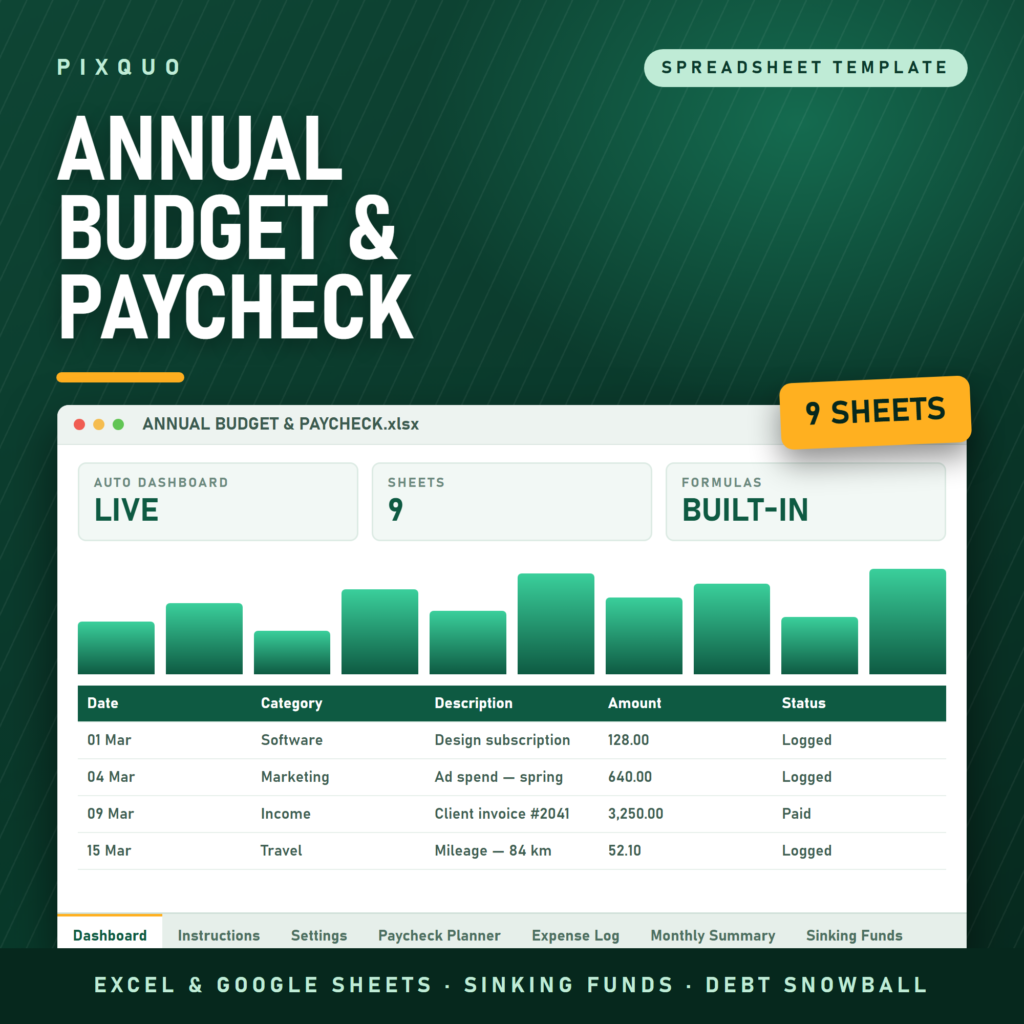
- Annual Budget & Paycheck Planner Spreadsheet — the day-to-day engine that makes next quarter’s net worth update a pleasure to enter.
- Subscription & Bill Tracker — trim the recurring costs that quietly drag on the asset side of your ledger.
- Side Hustle Income & Expense Tracker — if extra income is part of your net worth plan, track its real profit properly.
Learn more before you buy
Start with how to track your net worth for the full method, then see sinking funds explained and the debt snowball guide for the two habits that move the number fastest from each side of the ledger.
Frequently asked questions
How often should I update it?
Monthly or quarterly are the two rhythms that work. Monthly gives you a detailed trend and keeps the habit warm; quarterly is calmer and perfectly sufficient — net worth is a slow number by nature. What matters is a repeating calendar date. Updates take ten to fifteen minutes once the initial setup is done.
My net worth is negative. Is this tracker still for me?
Especially for you. A negative starting point is common — student loans plus a young career produce one almost automatically — and it changes nothing about the method. Your first entry is simply mile zero. Every debt payment from now on visibly raises the line, which makes payoff months feel like progress instead of money vanishing into a void.
Should I include my house and car?
Standard practice is yes — include the asset at a realistic current value and the mortgage or loan as a liability, so the tracker reflects your equity honestly. Some people prefer a separate “liquid net worth” view that excludes the home; the tracker’s category structure makes it easy to read your totals either way. Whichever convention you pick, keep it consistent so your trend line stays meaningful.
Does it connect to my bank accounts?
No — updates are manual, and for this use case that’s a genuine advantage. A net worth update is a deliberate look at your whole position a few times a year, not a live feed, and manual entry means no account credentials shared with any service and no third party holding your complete balance sheet. Fifteen minutes a quarter buys total privacy.
Does it work in Google Sheets and Excel? Any currency?
Yes and yes. The formulas are fully compatible with both Excel and Google Sheets, and the file opens in LibreOffice Calc too. Currency is simply the numbers you type — the tracker works identically in any currency, anywhere in the world.
What do I receive after purchase?
An instant digital download of the spreadsheet file — nothing ships. Your download links appear immediately after checkout and in your confirmation email, with re-downloads available from your account any time.
Instant download & license
This is a digital product with instant delivery and a personal-use license: use it on your own devices and within your household, but please don’t resell, redistribute, or publicly share the file. All sales on instant digital downloads are final — and if anything doesn’t work as described, contact us and we’ll make it right. This tracker is an organizational tool, not financial advice; for personalized investment decisions, consult a qualified professional.
Explore More Digital Tools
- Browse the full shop — planners, trackers, prompt packs and printables
- Free printables library
- Budgeting & saving guide · Planners & productivity guide
- Paper sizes & currency by country
Every Pixquo product is an instant download — no shipping, no waiting.

Reviews
There are no reviews yet.